From France to Africa, let us follow the clues left behind by their great autumn journey.
The September wire
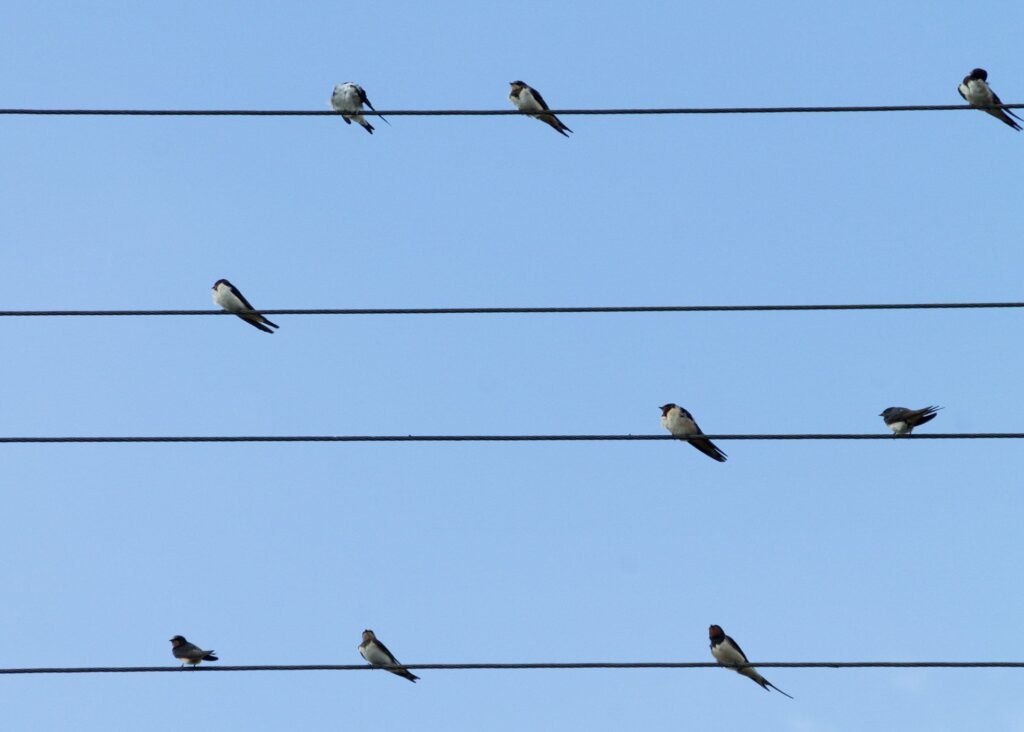
One September morning, there they are.
Lined up above the road: perhaps twenty, perhaps fifty, sometimes many more. They chatter, shuffle a few centimetres along the wire, burst into the air when a car approaches, wheel around for a moment, then settle almost exactly where they were before.
All summer, we have watched them streak across gardens, fly in and out of barns, skim past buildings and hunt insects over the fields.
Then suddenly, something changes.
There are more of them.
They are gathering.
And soon, the wire will be empty.
This familiar scene is no accident. It announces one of the great movements of the living world that passes quietly through our landscapes every year: the autumn migration of swallows.
At Pointe de l’Aiguillon in Vendée, the LPO’s annual post-breeding migration watch began on 1 September and will continue until 30 November. In an average autumn, several hundred thousand passerines of many different species pass through the site.At Fort de la Revère in the Alpes-Maritimes, early counts by LPO PACA have already recorded Bee-eaters, Honey Buzzards, Marsh Harriers, swifts — and swallows among them.
In Paris, police officers on bicycles were once nicknamed “les hirondelles” — “the swallows.” Their dark capes streamed behind them like wings as they cycled through the streets, and their bicycles were themselves associated with a brand called Hirondelle.But the symbolism surrounding the bird is much older. Across many European traditions, the return of the swallow announces spring. A swallow nesting beneath a roof has often been regarded as a sign of good fortune. Sailors, too, adopted the swallow as a symbol of travel — and, above all, of returning home.
It is difficult to imagine a more fitting emblem for a bird that can vanish for months and then return, sometimes to the very same area, the following spring.
Barn Swallow or House Martin?
Before following our traveller, we need to know who she is.
Two species are especially familiar around homes and villages in France and much of Europe.
The Barn Swallow (Hirundo rustica) has a reddish throat and a deeply forked tail, with two long, slender streamers. It is closely associated with farmland and often builds its open, cup-shaped mud nest inside barns, stables and other buildings.
The House Martin (Delichon urbicum) has white underparts and, most noticeably in flight, a bright white rump. Its upperparts are dark with a bluish sheen. It commonly builds an almost enclosed mud nest beneath eaves and cornices, leaving only a small entrance hole.
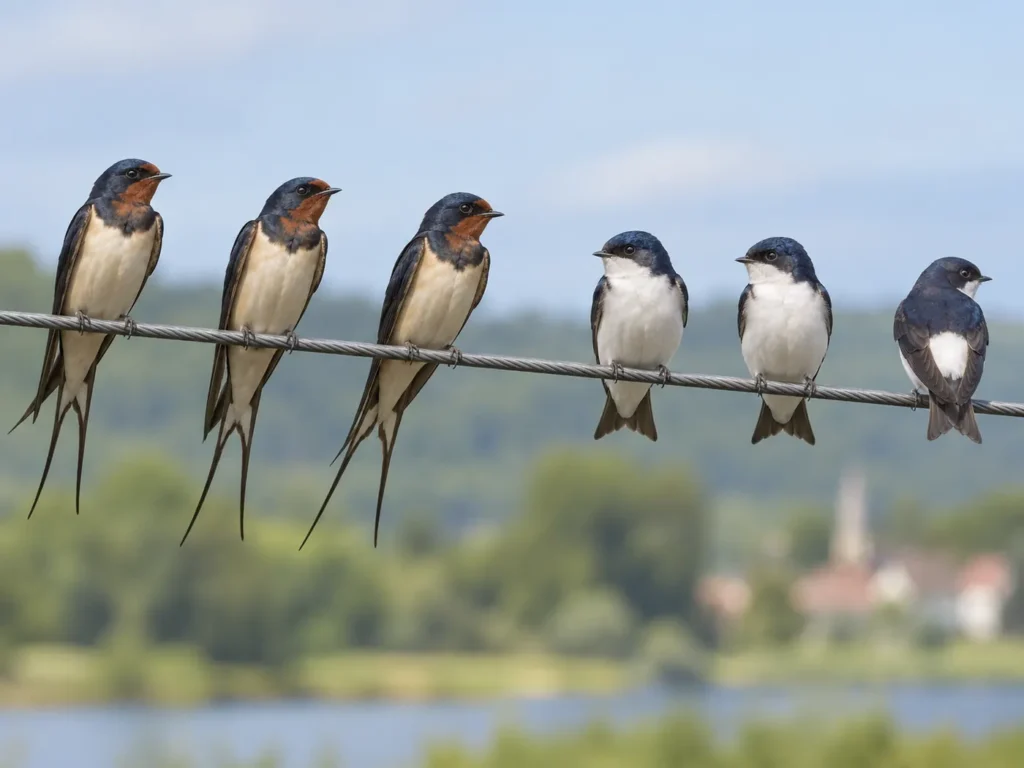
Barn Swallows, with their reddish throat and long forked tail. Right: House Martins, with white underparts and a clearly visible white rump.
Both migrate. But their calendars, habits and destinations do not always match exactly.
Barn Swallow: reddish throat, long forked tail, nest often inside buildings.
House Martin: white underparts and rump, mud nest beneath eaves.
A Barn Swallow may raise two broods during the breeding season and, under particularly favourable conditions, sometimes a third. A clutch usually contains around four or five eggs, which are incubated for roughly two weeks.
Barn Swallows can also show remarkable fidelity to their breeding sites. Many adults return to the same area, sometimes to the same building — even the same nest. Young birds are generally more adventurous. When they become breeders themselves, they may settle elsewhere. They leave the family home, so to speak.
And even the swallow’s love life is less straightforward than the romantic image we sometimes give it. The species is socially monogamous during breeding, but genetic studies have revealed extra-pair paternity. Biologists have also studied the male Barn Swallow’s long tail streamers extensively, particularly their possible role in mate choice and reproductive success.
Quite a lot happens beneath the beams of an old barn.
Why do swallows gather?
The gathering on wires is not a symbolic farewell ceremony. It is, above all, preparation.
From late summer onwards, young birds and adults that have finished breeding begin to form groups. Small gatherings gradually become larger. During the day, the birds hunt. In the evening, they may move into large communal roosts in reedbeds or other dense vegetation around wetlands. Where suitable natural vegetation is scarce, roosts can sometimes form in crops such as maize.
At this stage, feeding matters enormously. A few extra grams of stored energy may become precious when the birds cross regions where flying insects are far less abundant.
Large gatherings may also provide collective advantages: reducing individual predation risk, helping birds locate rich feeding areas, and perhaps allowing information to spread among individuals. Not all of these mechanisms are understood equally well.
One thing is certain: they do not all leave on the same morning. Some remain in the area for several more days while others have already begun moving south.
The image of swallows sitting along a wire feels timeless. Of course, it is not. Before telegraph, telephone and electricity lines spread across the countryside, swallows used other exposed perches: roofs, ledges, dead branches, bare trees and buildings. Their night-time roosts in reedbeds, however, already existed.And this behaviour contributed to one of the great mysteries of early ornithology. In the eighteenth century, some European naturalists still debated what happened to swallows in winter. Did they truly migrate to another part of the world — or did they enter some form of hibernation? The English naturalist Gilbert White, a remarkably careful observer of wildlife, also described swallows gathering in reeds. In his time, the belief that they might spend winter hidden in mud or at the bottom of ponds was still taken seriously.
Today, migration seems obvious to us. It was not always so.
Then, one morning, the wire is empty
Now let us follow a swallow. Not a real individual carrying a tracker whose every position we know, but an imaginary Barn Swallow whose journey brings together what scientists have learned from thousands of birds. We will simply call her our swallow.
She has spent the summer somewhere in France. Perhaps in an old barn. For several days she has been joining other swallows. She feeds, rests, flies again.
Then comes a morning that feels different. The wire above the road is empty. Our swallow has begun her journey.
She knows nothing of our departments, countries or borders. Ahead of her are simply changing landscapes, places to feed, favourable or contrary winds, opportunities to rest — and one broad direction: south.
Heading south
She crosses France in stages. Valleys, rivers, meadows and wetlands still offer concentrations of flying insects. She can feed while travelling and rebuild some of her energy reserves.
Unlike many small passerines, swallows migrate mainly by day. This allows them to catch flying insects as they travel and replenish part of their energy reserves along the way.
Depending on where they breed and where they spend the winter, European Barn Swallows may travel several thousand kilometres. Some populations breeding in France reach tropical or equatorial regions of Africa. Other European populations, particularly those originating farther north, continue much farther and may reach southern Africa.
There is therefore no single “swallow motorway.” There are many routes.
At the Organbidexka pass in the French Pyrenees, post-breeding migration monitoring runs from 15 July to 15 November. This mountain pass has long been an important place for observing and studying birds crossing the Pyrenees.
Our swallow may continue across the Iberian Peninsula. Again, she is not alone. Large roosts also form in Spain. Some can hold tens of thousands of birds.
Then the land narrows. Beyond it lies Africa.
Crossing the Mediterranean
European swallow populations use different routes to reach Africa. In the west, the Strait of Gibraltar is one of the most iconic passages. Elsewhere, birds use other routes around or across the Mediterranean.
During the sections flown directly over the sea, opportunities to land and feed are obviously greatly reduced. The wind therefore becomes an important ally — or an obstacle.
At Ceuta, overlooking the Strait of Gibraltar, ornithologists regularly organise migration-watching events. When weather conditions are suitable, this corridor offers a glimpse of the immense movement of birds travelling between Europe and Africa.
Once North Africa has been reached, another landscape begins. The Sahara. Across these vast arid regions, flying insects may become scarce or very unevenly distributed. The reserves accumulated earlier in the journey now become especially valuable.
Our swallow continues. Day after day. And somewhere, thousands of kilometres from the barn where she nested, her autumn journey finally begins to slow.
She has reached her wintering grounds.
Meanwhile, elsewhere…
While we imagine our French swallow moving south, other populations are following their own routes.
In the United Kingdom, birdwatchers and ornithologists follow the last autumn gatherings each year. A few months later, the same attention turns in the opposite direction as the first spring arrivals are reported.
In Switzerland, the Swiss Ornithological Institute uses tiny geolocators, among other techniques, to understand the movements of swallows from different European populations. These lightweight devices can help reconstruct parts of their journeys and reveal how much migration routes and wintering areas can differ.
In West and Central Africa, some European swallows spend several months doing what swallows do best: hunting insects. They do not build nests there to raise young. The nest left behind in Europe belongs to the spring and summer breeding season. In Africa, their task is different: to survive, feed, rest and wait for the time to travel north again.
In Gabon, for example, European Barn Swallows can be seen in open landscapes and around inhabited areas. As the European spring approaches, gatherings begin to appear again. The wires return to the story. This time, they signal a journey north.
And much farther south, something occurs that is difficult to imagine from our quiet French roadside.
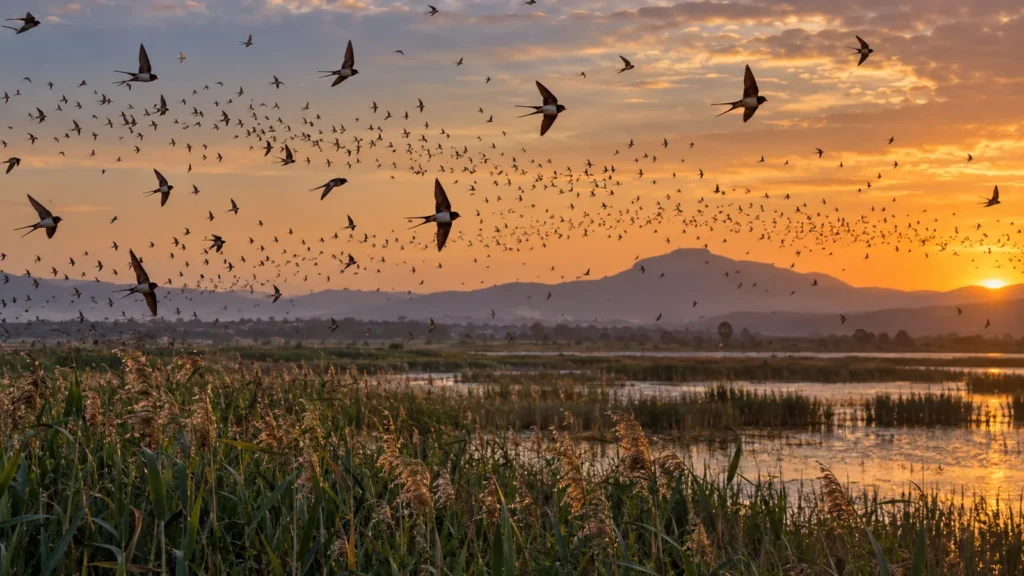
At dusk, large swallow roosts can gather thousands — sometimes millions — of birds above reedbeds before they settle for the night.
Millions of swallows at Mount Moreland
Near Durban in South Africa, Mount Moreland supports an enormous Barn Swallow roost. In the reedbeds of this wetland, estimates can reach several million birds, often around three million at the height of the season.
At dusk, the swallows arrive in waves. The sky fills. Then they pour down into the reeds for the night. The site has become important both for conservation and for observing this extraordinary migratory spectacle. Months later, the birds will leave again for the north.
At dusk, the great reedbed roosts change the scale entirely: what began as a few dozen birds on a wire can become a movement of thousands — sometimes millions — of swallows.
Where does a swallow sleep in Africa?
It is a wonderfully simple question that we rarely think to ask. She obviously does not fly back each evening to her nest in France.
In Africa, Barn Swallows frequently use communal roosts, particularly reedbeds and dense vegetation around wetlands. By day, they hunt. By night, they perch.
This is also one of the differences between their way of life and that of swifts, birds often confused with swallows when both are high in the summer sky. Swifts possess extraordinary aerial abilities and spend an exceptional proportion of their lives in flight. Swallows regularly return to a perch to rest. Even after travelling thousands of kilometres, our little traveller still needs somewhere to settle.
And what about the House Martin?
Meanwhile, the House Martin follows the season too. Its timetable can be slightly different. Late broods may still be present in September, so departures can be spread over a longer period. House Martins also migrate to wintering regions mainly south of the Sahara. And they, too, may gather before departure.
So when we look at the wires in September, several stories may be mixed together. A reddish throat. A white rump. A long forked tail. A fast-moving silhouette beside a house. All will head south, but not necessarily on the same day or to exactly the same place.
How do we know all this?
For a very long time, people did not even know where swallows disappeared to. Today, several methods allow researchers to reconstruct their journeys.
The first is bird ringing. A tiny ring carrying a unique number is fitted to a bird’s leg. If the bird is later recovered or captured again elsewhere — sometimes years later and thousands of kilometres away — two points in its life can be connected.
Geolocators brought another major advance. These extremely light devices record information such as changing light levels. If the device is recovered, researchers can estimate the bird’s movements between seasons.
Radar allows migration to be studied at an entirely different scale, revealing the direction and intensity of movements and, in some situations, the altitude or speed of migrating birds.
And some ring recoveries are enough to make your head spin. A Barn Swallow ringed in Johannesburg, South Africa, was recovered only 34 days later near Leninsk in Russia, after travelling approximately 10,500 kilometres. An exceptional case. But one that reminds us what a bird weighing only a few tens of grams can achieve.
And yet, we still do not know everything
Perhaps that is what makes migration so fascinating. We have satellites, radar, rings, geolocators, thousands of observers and decades of research. And yet every swallow retains part of its mystery.
We know the broad routes. We know some of the great roosts. We can connect a bird ringed in Europe with another point somewhere in Africa. But we do not know where every single swallow leaving our village goes.
The one nesting beneath that beam. The one hunting over the meadow every evening. The one that was sitting on the wire yesterday. Perhaps she is already hundreds of kilometres away. Perhaps she is still nearby.
And this is where we, too, can become observers.
Are they still with you?
Look at the wires. The rooftops. The meadows. The ponds. The old barns.
If you see swallows, take a few seconds to record the date, the nearest town or village, their approximate number, the species if you can identify it, and what they were doing. If you cannot tell a Barn Swallow from a House Martin, that does not matter. Simply write: “swallow — species uncertain.”
Perhaps you will see fifty today. Ten three days from now. Then none at all. Or perhaps birds from farther north will pass over your village after the local swallows have already left.
There is no single moment when “the swallows leave.” Migration is movement. A vast wave made up of millions of individual journeys.
And when the wire is finally empty one morning, we will know that they have not simply vanished. Somewhere beyond our roads, our borders and the Mediterranean, their story continues.
And next spring, when the first familiar silhouette cuts through the sky above the village, we may find ourselves asking another question:
Could this be one of the swallows we watched leave?
Watching a gathering, distinguishing the species, locating a roost, noting behaviour or the presence of a predator: these are simple ways to look more closely at what is happening around us. A future practical Confrérie notebook will extend this Echo with a field observation sheet. In the meantime, discover the Chevaliers de l’Astrée, our story and ways to take part.
Sources and organisations mentioned
LPO (Vendée, PACA, Aquitaine), Swiss Ornithological Institute (Vogelwarte), BirdLife South Africa / Mount Moreland Conservancy, Sociedad de Estudios Ornitológicos de Ceuta, Tour du Valat. Precise references to be added before publication.
Your voice matters
Respond to this Echo
An observation, experience or question? Share it here. Comments are reviewed before publication.
No published comments yet. You can start the conversation.