A few days ago, we came across the story of a small village in Seine-Maritime that wants to restore natural spaces, ponds and planted areas around one simple idea: recreate favourable conditions for biodiversity… and then let nature do part of the work.
That sentence made us stop.
Because at Eaux de Velours, in La Roche-Posay, this is precisely what we are learning. And we first learned it the hard way.
At first, we simply wanted to do things properly
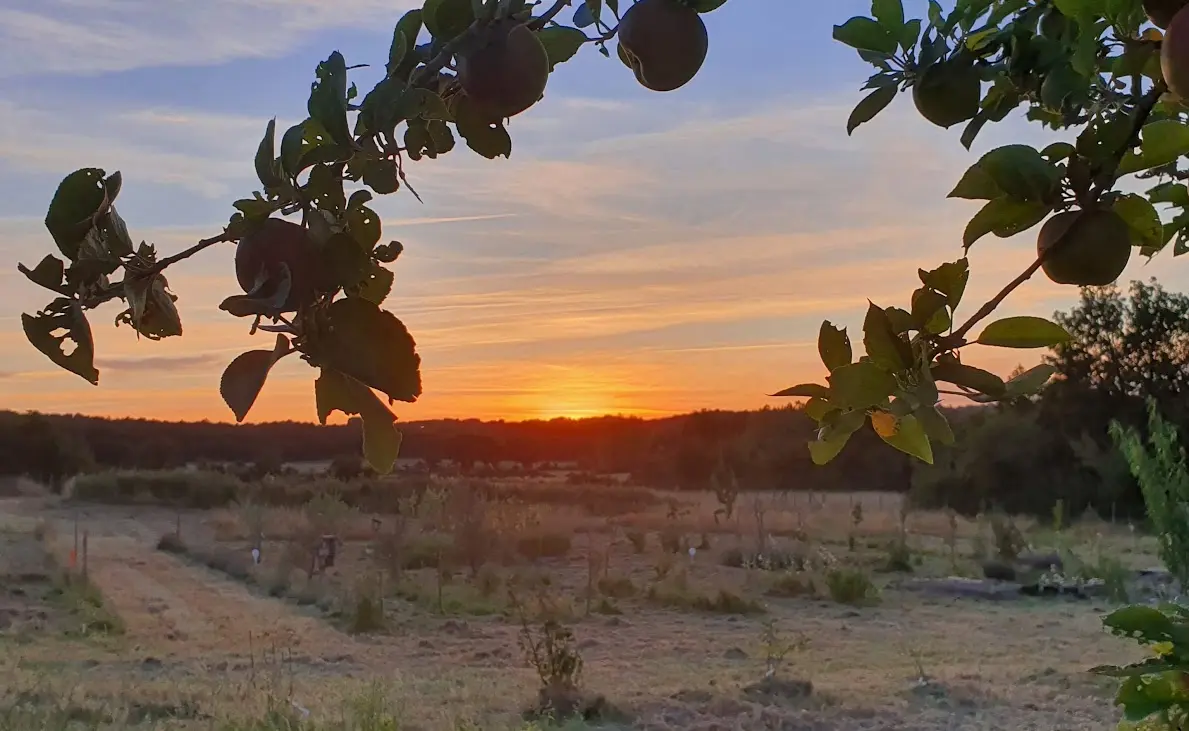
We began imagining and planting this food forest around 2016, gradually, according to the means available to us and the time we could devote to the land.
It was never one large project completed all at once, but a succession of trials, plantings, observations and adjustments over the years.
Then watering.
Then hoping.
On paper, everything made sense. Yet little by little, the land reminded us of something essential: a living place does not always allow itself to be managed like a project drawn in advance.
Despite specialist advice, despite our care and good intentions, some trees simply never found their place. Many persimmon trees, among others, eventually died. Other plantings held on for a while before disappearing.
We had to look at things as they were, rather than as we wanted them to be. And accept that we had made a mistake.
We had probably spent too much time trying to make the land fit our plan.
Then we let the land reclaim some space
Successive heatwaves took their toll. Many plants struggled, some disappeared, and a personal change altered our priorities and the time we could devote to the project.
At some point, we had to stop fighting what had become obvious: we could no longer maintain the project as we had first imagined it.
So we let it go.
Since then, the land has become overgrown. And perhaps that word, so often used as though it meant failure, deserves to be looked at differently.
Because while we stopped organising everything, the living world carried on.
Some plants settled in without asking our permission. Others thrived where we had never expected them to. Species we had carefully selected disappeared, while spontaneous plants found their own place quite naturally.
Instead of asking:
“What do we want to plant here?”
we now try to ask:
“What is this land trying to show us?”
We observe where water lingers longest. Which plants return every year. Which areas keep their freshness, which dry out more quickly in the sun, where insects gather and where birds seem happy to stop.
Understand first. Intervene second.
This change of perspective may be the most important lesson Eaux de Velours has taught us.
But what do we mean by a biodiversity oasis?
The word “oasis” may bring to mind a lush place filled with trees, flowers and animals. Yet a biodiversity oasis does not need to be spectacular.
It is, above all, a place where different forms of life can find food, shelter, breeding space and pathways through which to move and survive the seasons.
A meadow that is not all mown at the same time can contribute. So can a varied hedge. A pond, an ageing tree, a few dead branches left on the ground, a pile of stones, tall grasses, a damp area, or simply a corner where we choose not to intervene can each become a small habitat.
Creating a biodiversity oasis therefore does not mean filling a piece of land with different species so that we can count them afterwards. It means providing — or preserving — a sufficiently wide range of conditions for life to settle in.
And sometimes the first useful action is simply not to remove what is already there.
Letting nature take its course does not mean doing nothing
We have no wish to turn Eaux de Velours into completely abandoned land.
What we want is balance: to support what works naturally and intervene more thoughtfully when doing so can enrich the habitat.
Protect the water. Maintain different heights of vegetation. Keep some open areas and others more secluded. Encourage shrubs, hedges, trees and meadow plants. Leave dead wood when it poses no danger.
And sometimes, plant again.
But differently.
Flowers from late winter through to autumn
One of the aims we would like to pursue is very simple: to help pollinating insects find flowers for as much of the year as possible.
Queens of some bumblebee species can emerge from late winter onwards. Then come spring and summer, before floral resources gradually become scarcer in autumn.
So we would like first to observe what already flowers at Eaux de Velours, and especially to identify the moments when food becomes scarce. Then, if necessary, fill those gaps.
Not by planting a great deal. By planting in the right place and at the right time.
We could imagine a kind of flowering relay: the first blooms of the year passing the baton to the next, then to others, all the way through to the last flowers of September and October.
Living things do not follow our gardening calendars. For a hungry bumblebee emerging from winter, or an insect still searching for nectar in autumn, a few flowers at exactly the right moment can be far more valuable than a spectacular burst of bloom concentrated into three weeks in May.
And what if some of those flowers later became fruit?
This is where we would like to add something very important to the project: a human dimension.
We would truly love to see raspberry canes and redcurrant bushes find a place at Eaux de Velours.
Not because we want to return to the idea of a perfectly organised food forest, but because these small fruits express exactly what we would like to create.
In spring, their flowers feed insects. Then the fruit comes. Birds may take some before we do — and that is perfectly fine. Others may one day fill a few baskets.
And then, why not imagine a gathering of Les Chevaliers de l’Astrée at Eaux de Velours?
A small harvest of raspberries, redcurrants or blackberries. A few baskets. A table. Preserving pans. Sugar. Jars. And jelly made together.
It would be an almost perfect way of connecting biodiversity and people.
From flower to bumblebee, from fruit to gathering
Because behind a simple redcurrant bush, an entire story is already unfolding.
A flower opens. An insect comes for nectar or pollen. Pollination allows fruit to form. A bird may eat some of it. A person picks a few clusters. Then several people gather in a kitchen to transform the harvest.
Everything is connected.
Biodiversity is not a collection of species placed side by side. It is a web of relationships.
Between a plant and an insect. Between a fruit and a bird. Between water and soil. Between a hedge and the animals that shelter there. And sometimes, between a place and the people who take the time to gather there.
We still want to plant. Just differently.
Our earlier experience did not teach us to give up. It taught us to listen.
We will probably plant a few more trees and shrubs. We will certainly try raspberries and redcurrants. We may look for other flowering and fruiting plants that can genuinely adapt to the land.
But we will no longer begin with a plan that simply has to succeed.
First we will look at the soil, the water, the shade, the wind, the plants already present, the insects and the birds.
And if the land says no, this time we will try to hear it.
Learning to give nature room
Creating a biodiversity oasis at Eaux de Velours does not mean manufacturing an ideal garden. Still less does it mean artificially rebuilding a version of nature we have already designed in our heads.
It means looking for a balance between guidance and freedom.
Protect what works. Restore when necessary. Add sparingly where something can genuinely enrich the place. Then wait. Observe. Sometimes make another mistake. And learn.
Perhaps a biodiversity oasis begins precisely there: not when people finally succeed in organising everything, but when we accept that we are no longer the only ones making the decisions.
At Eaux de Velours, we spent a long time trying to plant what we wanted to see grow. Now we want to discover what the place itself is capable of becoming.
fruit to carry it forward,
and sometimes a harvest to bring us together.
And perhaps, in the end, creating a biodiversity oasis is less about adding nature… than about giving it room.
This article was inspired in part by an initiative in La Crique, Seine-Maritime, involving the restoration of natural areas, ponds and shared gardens, reported by Le Réveil de Neufchâtel / actu.fr on 31 August 2026.
Your voice matters
Respond to this Echo
An observation, experience or question? Share it here. Comments are reviewed before publication.
No published comments yet. You can start the conversation.