Why do large spiders suddenly become so visible in September? How does an orb-weaver build its web without getting stuck in it? And what are those silvery threads that autumn lays across fields?
The large spiders noticed in autumn do not all suddenly arrive to escape the cold: among house spiders, it is mainly adult males that begin roaming in search of a female. The traditional French “fils de la Vierge” — gossamer threads — are linked to the aerial dispersal of small spiders. And a spider web is not simply a net: it can be a trap, a material, an alarm system and, for some species, almost an extension of their senses.
I. The September mystery
Every year, the same scene returns. You walk into the bathroom and a large, fast brown spider darts under the bath. Panic, a shout, a call for help — although in some households the person being called is not necessarily any keener.
Why now? At the end of summer and the beginning of autumn, adult males of several large house-spider species, especially funnel weavers in the Eratigena group, leave their webs and begin wandering in search of a mate. That roaming makes them suddenly much more visible. Baths and sinks can then act as accidental traps: the spider falls from a wall or edge and cannot climb back up the smooth surface.
So, contrary to a common belief, there is no great “autumn invasion”. Many of these spiders were already living discreetly in the building, and some may also enter from outside through a window, door, crack or chimney. What changes most is their behaviour.
Are they dangerous? The large house spiders found in our homes do not normally pose a danger to people. Medically significant spider bites are rare in France and are often difficult to attribute with certainty to a particular species. A few Mediterranean spiders, especially Latrodectus species — including the European black widow or malmignatte — and some Loxosceles, can cause more serious incidents, but that has nothing to do with the large house spider crossing the living room.
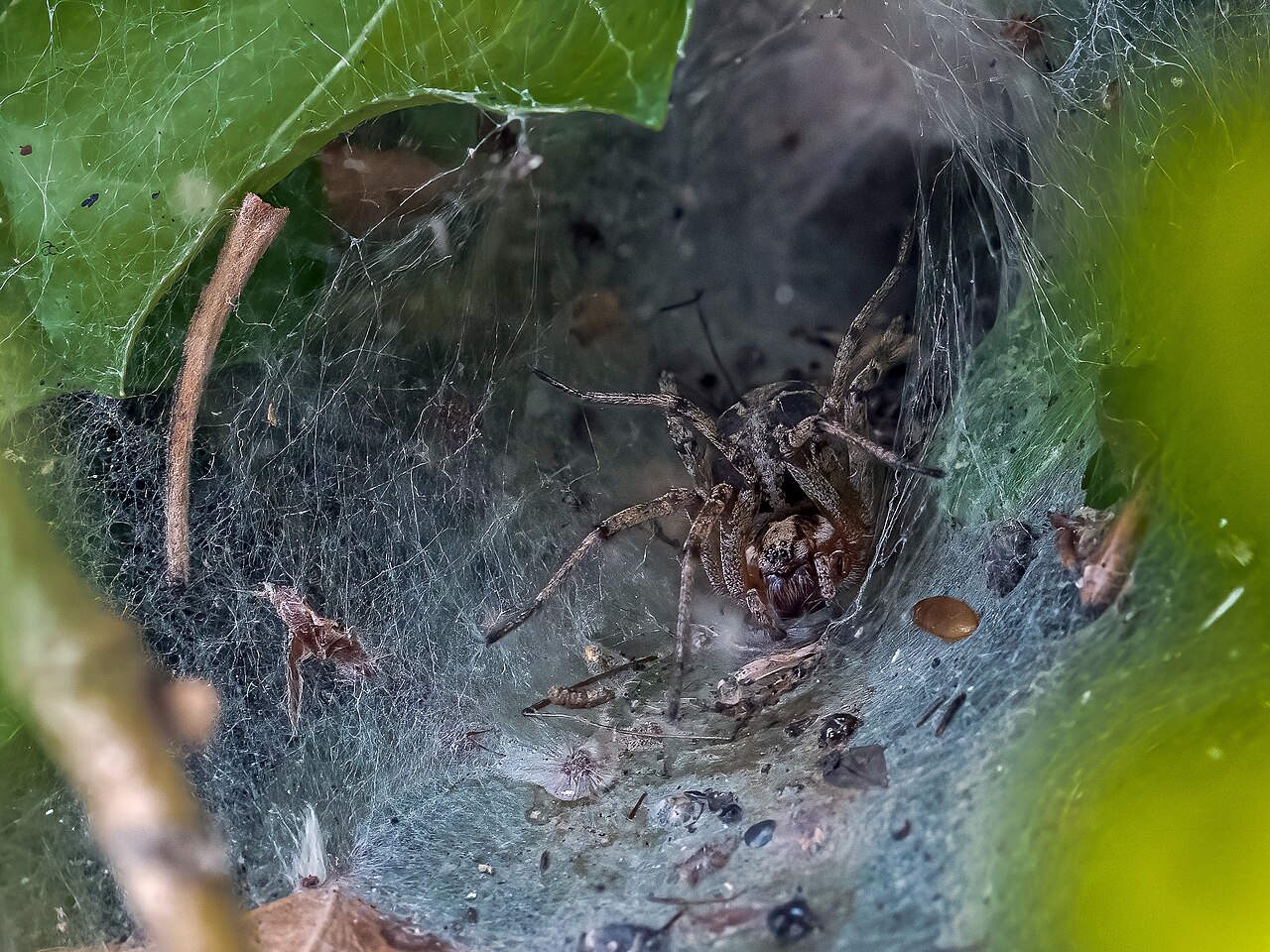
A giant house spider at the entrance to its funnel web. Photo: Isiwal / Wikimedia Commons, CC BY-SA 4.0.
II. Spider rescue: the right move
No insecticide and no epic duel are needed. A glass and a piece of card are enough: place the container over the spider, gently slide the card underneath, then move it to a quiet, sheltered place.
If it is trapped in a bath or sink, a simple towel reaching down to the bottom can serve as a ladder. It will often climb out by itself. For a species that lives in buildings, in midwinter it is better to choose a garage, cellar, shed or protected corner rather than a lawn exposed to frost.
Horse chestnuts, essential oils and other supposed spider repellents have very variable effectiveness and little solid evidence behind them. Gentle capture remains the simplest way to solve the problem without turning the bathroom into a chemical-warfare laboratory.
Clean the area, monitor how it changes and seek medical advice if the pain becomes intense, the redness spreads or general symptoms appear. If the animal is still visible, a photograph taken without handling it may help with identification.
III. The web: a masterpiece of engineering
The large spider crossing your living room does not necessarily build the round web seen in books. Funnel-weaving house spiders make a sheet of silk ending in a tube or funnel where they wait in ambush. Their capture threads do not need to be sticky: prey running across the sheet transmits vibrations, and the spider rushes out from its retreat.
The geometric wheel-shaped web belongs in particular to orb-weavers. Its construction follows a remarkable sequence: supporting threads, radii, a temporary spiral and then the capture spiral. Depending on the species, parts of the web are frequently renewed and the silk may be recycled by the spider.
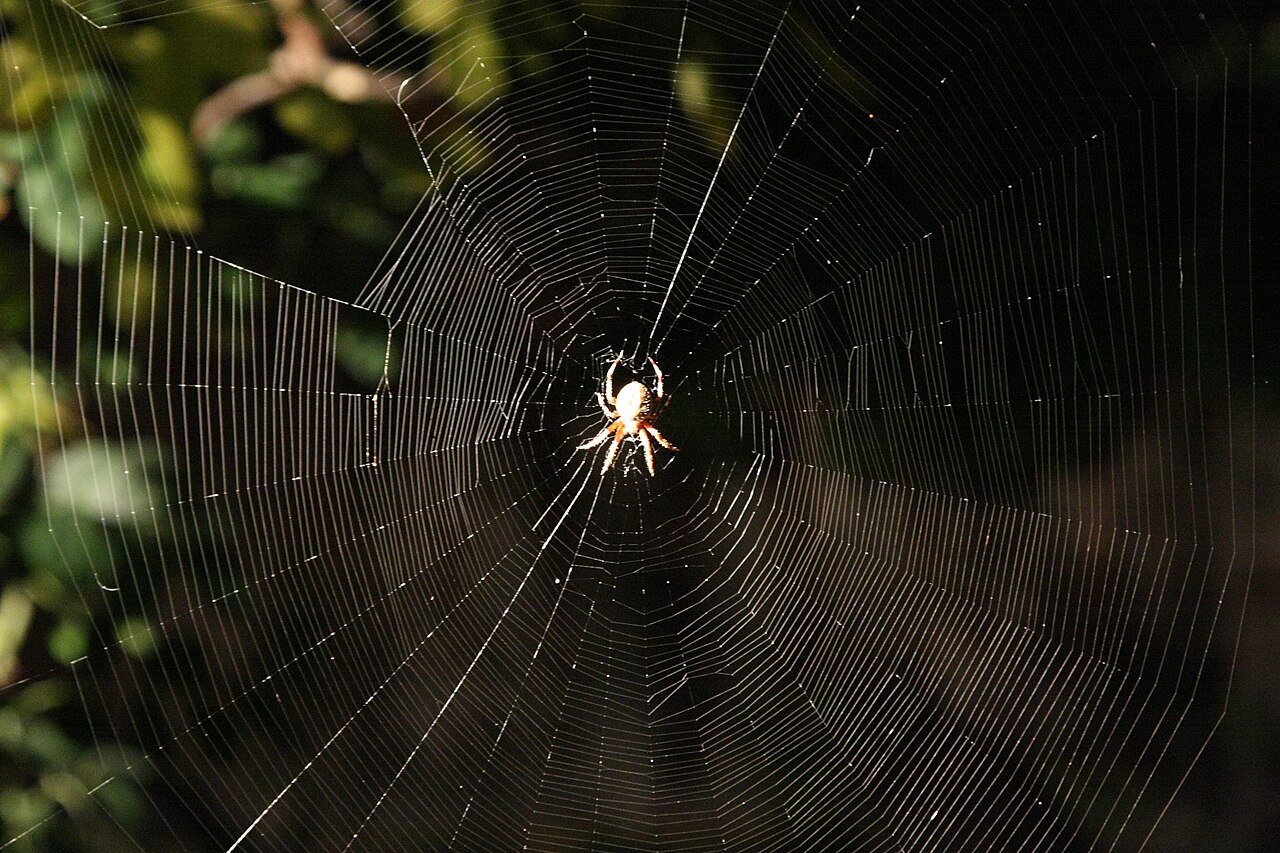
An orb-weaver web. Photo: Gnissah / Wikimedia Commons, CC BY-SA 3.0.
And why does the spider not stick to its own trap? Studies point to a combination of solutions: it limits contact with adhesive areas, the hairs on its legs reduce the contact surface, and the surface of the legs also has chemical properties that reduce adhesion. The engineering is therefore not only in the web: it is also in the legs of the animal that built it.
IV. A coveted material: spider silk
Silkworm silk and spider silk are both protein-based materials, but they are not identical. Silkworms mainly produce fibroin; spiders have families of proteins called spidroins and, above all, several glands capable of producing different silks for different purposes: safety line, structure, capture, egg sac or prey wrapping.
Spider silk fascinates engineers because it combines strength, lightness and stretch, giving it exceptional toughness. But the simple slogan that it is “stronger than steel” in every sense should be avoided: performance depends on the type of silk and the property being measured.
The industrial difficulty lies elsewhere: spiders cannot be farmed in dense groups like silkworms. They are territorial, often prey on one another, and produce only modest quantities of silk.
The most spectacular example remains the spider-silk textiles made in Madagascar by Simon Peers and Nicholas Godley. Golden orb-weaver spiders were collected, temporarily placed in a device that allowed their silk to be reeled — several dozen at a time — and then released. The project required years of work and more than a million spiders for some pieces now shown in major museums. Other teams are exploring a radically different route: using genetically modified silkworms to produce spider-silk proteins.
V. Gossamer threads: when spiders take to the air
At the end of summer and in autumn, long silvery threads can sometimes be seen floating through the air and then settling across fields, hedges, fences or vineyards. In France they are traditionally called “fils de la Vierge”, literally “the Virgin’s threads”.
They are associated with ballooning, a strategy of aerial dispersal. Small spiders — often Linyphiidae, though not only them — climb to a high point, release silk threads and allow themselves to be carried away when conditions are favourable. Silk accumulated across the landscape after these departures becomes especially visible in dew and low-angle light.
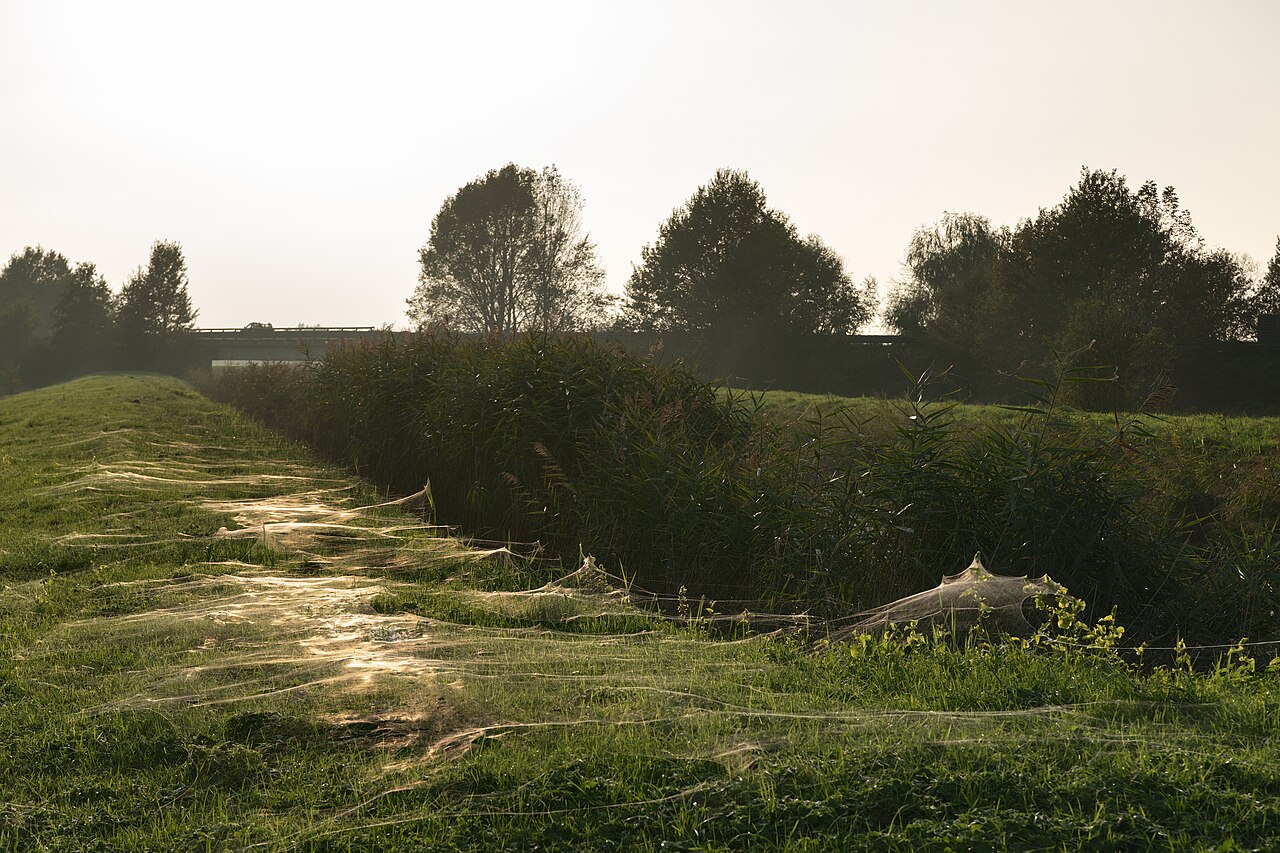
Silk threads after an episode of aerial dispersal. Photo: Giorgio Galeotti / Wikimedia Commons, CC BY-SA 4.0.
Wind may not be the only actor. Experiments at the University of Bristol showed that spiders can detect the atmospheric electric field and that fields of natural intensity can help trigger ballooning and contribute to the lift acting on silk. This does not replace aerodynamics: it adds another mechanism to an already remarkable story.
When a field seems covered with silver threads on an autumn morning, you are not looking at a collection of abandoned webs. You are seeing traces of living creatures dispersing across the landscape.
VI. Who are they really? A family portrait
Several different groups hide behind the label “large house spider”.
Funnel-weaving house spiders are the large brown spiders with long legs often found on floors, in cellars, garages and quiet rooms. Adult males become particularly mobile at the end of summer.
Cellar spiders have a small body suspended on extraordinarily long legs. They live in loose webs, often in ceiling corners.
False widows in the genus Steatoda have a rounder abdomen and build irregular webs. They are not aggressive; as with all spiders, simply avoid handling them with bare hands.
The Mediterranean false wolf spider (Zoropsis spinimana) is more robust and strongly marked. Originally Mediterranean, it is now observed far beyond its historical range and may enter houses.
Abroad, the picture changes little: in the United Kingdom, large house spiders belong to the same groups; in North America, several European Agelenidae have been introduced. The famous “hobo spider” long carried a reputation for dangerous bites much stronger than current medical evidence supports.
VII. Which spider am I looking at?
- House funnel weaver: large, brown, long-legged; on the floor or low on a wall; sheet web with a funnel.
- Cellar spider: tiny body and extremely long, thread-like legs; suspended in a loose web high up.
- Orb-weaver: abdomen often rounded and patterned; mainly outdoors; large geometric orb web.
- Jumping spider: small and compact, large forward-facing eyes; moves in jumps; hunts by sight without a capture web.
- False widow: rounded brown-to-dark abdomen; irregular web in a sheltered corner.
- Harvestman or “daddy longlegs”: not a true spider of the order Araneae. Its body appears as one piece and it does not produce a hunting web.
This key allows only a rough identification. Distinguishing two closely related species with certainty may require examination of fine characters — sometimes under a microscope. A clear photograph is therefore better than heroic certainty.
VIII. The secret life of a house spider
When a male finds a female’s web, he does not rush onto it like an unwary fly. He produces vibratory signals that play a role in recognition between partners. Autumn is therefore the season when we see many males on the move.
After mating, females place their eggs in a silk sac in a protected location. In large European house spiders, young generally emerge in spring or during the warmer season, grow for several months and pass through a succession of moults.
Life cycles vary between species and according to conditions. That is precisely why very precise figures should be treated cautiously when applied indiscriminately to “the house spider”: several species with different rhythms hide behind the common name.
IX. One family, a thousand strategies
- Funnel-weaving house spiders: ambush hunting from a silk sheet connected to a retreat.
- Orb-weavers: orb-shaped traps with adhesive capture zones.
- Cellar spiders: long-lasting irregular webs inside buildings.
- Linyphiidae: small sheet webs and, in many species, spectacular aerial dispersal.
- Crab spiders: ambush on flowers or vegetation, without a capture web.
- Jumping spiders: visual hunting and carefully judged leaps.
The same animal order, but radically different solutions: wait, trap, leap, camouflage or fly.
X. Why are we afraid? Biology and imagination
Arachnophobia is real and can become very disabling. Estimates vary between studies and definitions, but a clinical phobia affects a minority of the population, while mild fear or discomfort is much more common.
Research with very young children has shown that images of spiders or snakes can trigger stronger attention or physiological activation than other images. This does not prove that babies are “afraid” of spiders in the clinical sense. It supports instead the idea of an early sensitivity to certain shapes, upon which learning, culture and personal experience may later build — or not build — a lasting fear.
Early twentieth-century psychoanalysis sometimes interpreted the spider as a figure of the “feared mother” or of castration anxiety. That reading belongs mainly to the history of ideas. Contemporary psychology relies much more on learning mechanisms and on gradual exposure therapies when a phobia needs treatment.
Western imagination has also loaded the spider with a heavy symbolic burden. In Greek mythology, Arachne, a prodigious weaver, challenges Athena before being transformed. By contrast, in West African and Caribbean traditions, Anansi is a figure of cunning, storytelling and the transmission of knowledge. Depending on where one is born, the spider can therefore be monster, artist, messenger or storyteller.
As for the French saying “morning spider, sorrow; midday spider, worry; evening spider, hope”, it belongs to weather folklore. Spiders do indeed change their activity according to humidity, wind and rain, but the saying is obviously not an officially certified weather station.
XI. True or false: seven common beliefs
“We swallow eight spiders a year while sleeping.” — False. No serious scientific study supports this figure. It is an urban legend, and its exact origin is itself far less certain than some internet stories claim.
“A mark noticed on waking is probably a spider bite.” — Usually false. Many skin lesions blamed on spiders have other causes. Even in clinical toxicology, identifying the responsible species is often impossible.
“Spiders are insects.” — False. They are arachnids: adults have eight legs and a body plan different from that of insects.
“All spiders build webs to hunt.” — False. Jumping spiders and crab spiders, among others, hunt without a capture web.
“One spider can make several kinds of silk.” — True. Different glands produce materials adapted to different functions; in some species, several types of silk and glue can be distinguished.
“The spider in the bath came up through the drain.” — Very unlikely in most cases. It usually fell from a wall or the edge and then became trapped by the smooth surface.
“A very clean house has no spiders.” — False. Their presence depends mainly on access to the building, available hiding places and the small prey present. They do not issue certificates of poor housekeeping.
XII. Autumn mission: the eight-legged notebook
Choose a corner of the garden, a window, a cellar or a quiet room. For seven days, note the time, weather, location, type of web — or its absence —, the spider’s approximate size and behaviour and, if possible, take a photograph without disturbing it.
This small protocol immediately changes the way you look. Instead of seeing simply “a spider”, you begin to distinguish one sitting still in a web, a male on the move, a visual hunter, a new web built overnight or a thread revealed by dew.
Natural-history observations in France can be submitted through INPN Espèces, the citizen-science app of the French National Inventory of Natural Heritage, contributing to knowledge of French biodiversity.
The practical notebook The world seen through eight legs extends this feature: how does a house spider perceive a vibration? Why can a web function as an extension of the senses? How can you carry out a small observation experiment without touching the animal? Members can now find this notebook in the Fellowship.
XIII. The unloved need us too
The first national Red List devoted to spiders in metropolitan France assessed 1,622 species. It classified 170 as threatened and 101 as near threatened. More than one species in ten assessed is therefore already in a worrying situation.
The causes vary: destruction and fragmentation of habitats, loss of old trees and microhabitats, drying of wetlands, soil artificialisation, and intensive agricultural or forestry practices. Spiders are predators of many small animals, prey for other species and indicators of the quality of certain habitats.
We fear a few very visible individuals in our homes while much more discreet species disappear quietly. Perhaps that is the most interesting reversal in this whole story: the large September spider is not the intruder. It is an opportunity to look more closely at a world we almost always ignore.
And sometimes all it takes is a thread.
Sources and further reading
French Committee of the IUCN, Red List of spiders in metropolitan France (2023); Muséum national d’Histoire naturelle / INPN; Natural History Museum, “House spider” feature; British Arachnological Society, “Spiders in the House”; University of Bristol, research on atmospheric electric fields and ballooning; French poison-centre study on spider bites; experimental research on anti-adhesion properties of orb-weaver legs; Victoria & Albert Museum, Golden Spider Silk project.
Photo credits: Isiwal / Wikimedia Commons (CC BY-SA 4.0); Gnissah / Wikimedia Commons (CC BY-SA 3.0); Giorgio Galeotti / Wikimedia Commons (CC BY-SA 4.0). The files have been imported into the site media library to avoid external image links.
Your voice matters
Respond to this Echo
An observation, experience or question? Share it here. Comments are reviewed before publication.
No published comments yet. You can start the conversation.