Echoes of the Living World · Prevention
Wildfires
Protecting your home without stripping the land bare
In one minuteClearing vegetation does not mean stripping the land bare. The aim is to reduce the amount of combustible vegetation and break the continuous pathways that allow fire to move from the ground to shrubs, then trees and buildings. Rules vary from one area to another, so local guidance should always be checked.
In this feature
- Know the danger level
- Understand how fires start
- Clear vegetation without removing everything
- Check local requirements
- Protect small wildlife
- Manage cut vegetation
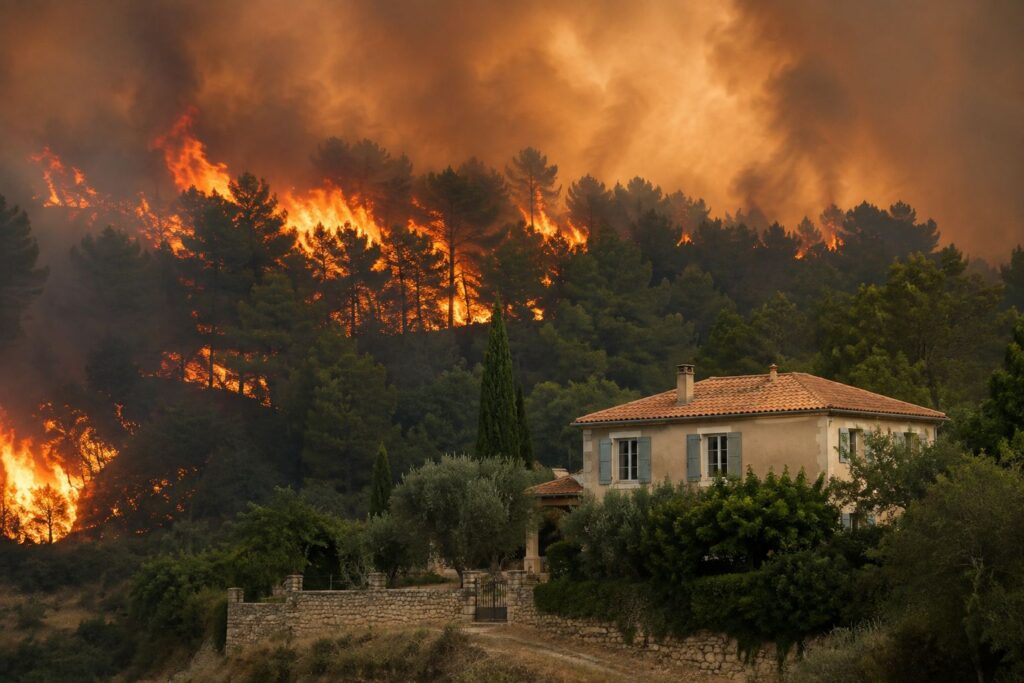
When summer arrives, one expression is heard everywhere in parts of France: vegetation clearance. It is a legal obligation in some areas and common sense wherever wildfire risk is rising, yet it can sometimes be misunderstood ecologically.
Through fear or excessive zeal, some owners remove hedges, scrub and undergrowth until their land becomes almost bare. Protecting a home from wildfire does not mean removing all life around it. It means acting in the right place, at the right time and for the right reason.
✦
Before taking action
Know the danger level
Heat, wind, air humidity, dry soils and the condition of vegetation strongly influence both the outbreak and spread of wildfire. An activity that may be acceptable after several damp days can become dangerous during hot, dry and windy weather.
In France, Météo-France publishes a daily wildfire danger map during the summer season, using four levels: low, moderate, high and very high. The map provides information about danger; actual prohibitions are set by local authorities through orders and specific instructions.
Before any authorised burning, spark-producing work or other risky activity, check the official map as well as guidance from the prefecture, local council and relevant local services.
Common causes of preventable fires
Most wildfire outbreaks are linked to human activity
- a cigarette end thrown beside a road or into vegetation;
- a barbecue placed too close to dry grass;
- a campfire or burn that escapes control;
- welding, grinding or cutting work;
- a tool or machine producing sparks;
- wood, gas cylinders or combustible materials stored against a building.
The right approach
What does vegetation clearance actually mean?
Vegetation clearance means reducing the amount and continuity of combustible plant material. Depending on the land and local requirements, this may involve removing accumulated dead wood, thinning some shrubs, pruning low branches and preventing vegetation from forming a continuous route between the ground, trees and the building.
The goal is not to create an empty landscape. It is to slow the fire, reduce its intensity close to the home and keep access routes usable for emergency services.
The legal framework
The rules are not the same everywhere
In France, in areas subject to statutory vegetation-clearance requirements, the surroundings of buildings generally have to be maintained to a depth of 50 metres. This distance may be increased locally, and the exact methods depend in particular on prefectural orders, the municipality and the situation of the property.
The figure of 50 metres is therefore not a universal rule for every plot of land. Before major work, check whether the property is affected and which requirements apply.
Key points
- Reducing fuel does not mean removing all vegetation.
- Dry material and continuous vegetation linking ground, shrubs and trees are priority concerns.
- Spark-producing work should be avoided during periods of high danger.
- Required distances and techniques vary by location.
- Fire-resilient land is maintained regularly, not only at the height of summer.
Cut without destroying
Protect nests and small wildlife
Where safety allows, major work is best anticipated in autumn or winter. Before cutting, inspect hedges, scrub, hollow trees and piles of branches to avoid destroying an occupied nest or refuge.
Dead wood has ecological value, but it becomes hazardous when accumulated close to a home or forming part of a continuous fuel pathway. If it is retained for biodiversity, its location should be chosen away from buildings and in accordance with local rules.
After the work
What should be done with cut vegetation?
Creating a large pile of branches against a house cancels out part of the benefit of vegetation clearance. Depending on local rules, cut material may be chipped, composted, taken to a waste facility or handled through an appropriate disposal service.
Open-air burning is prohibited or tightly controlled in many areas. It should never be treated as an automatic solution.
Frequently asked questions
Common questions
Do all trees around a house need to be cut down?
No. Trees may be retained if their position and maintenance comply with local requirements and do not create a dangerous fuel pathway towards the building. Does the Météo des forêts map prohibit certain activities?
No. It provides information about the danger level. Restrictions are decided by local authorities through specific orders and instructions. Are broadleaved trees always less flammable than conifers?
No. Fire behaviour depends on the species, how dry it is, its maintenance, foliage density and the amount of dry material that has accumulated. Can a hedge be kept near the house?
Yes, in some cases, but its density, position and maintenance must be compatible with local requirements and building safety. Should vegetation clearance wait until summer?
No. Major work should be anticipated before the dry season, whenever conditions and regulations allow. Can dead wood be kept for biodiversity?
Yes, but not against the building or within a continuous fuel pathway. Its location should be chosen carefully.
Astrée’s perspective
Protecting a living place means neither abandoning it nor erasing everything that grows there. It means acting with judgement so that people’s safety, the protection of buildings and care for the living world can move forward together.
Sources to consult before taking action
- Météo-France — Météo des forêts
- Service-Public.fr — statutory vegetation-clearance requirements
- French Ministry of the Interior — wildfire prevention
Continue the feature
In the Chevaliers’ Realm
A practical sheet helps prepare land maintenance, check local rules and keep a record of work carried out.
Your voice matters
Respond to this Echo
An observation, experience or question? Share it here. Comments are reviewed before publication.
No published comments yet. You can start the conversation.