Echoes of the Living World · Water and the cycles of life
Where Does Water Really Go?
The journey of water that was circulating long before us and will continue after us
In one minute
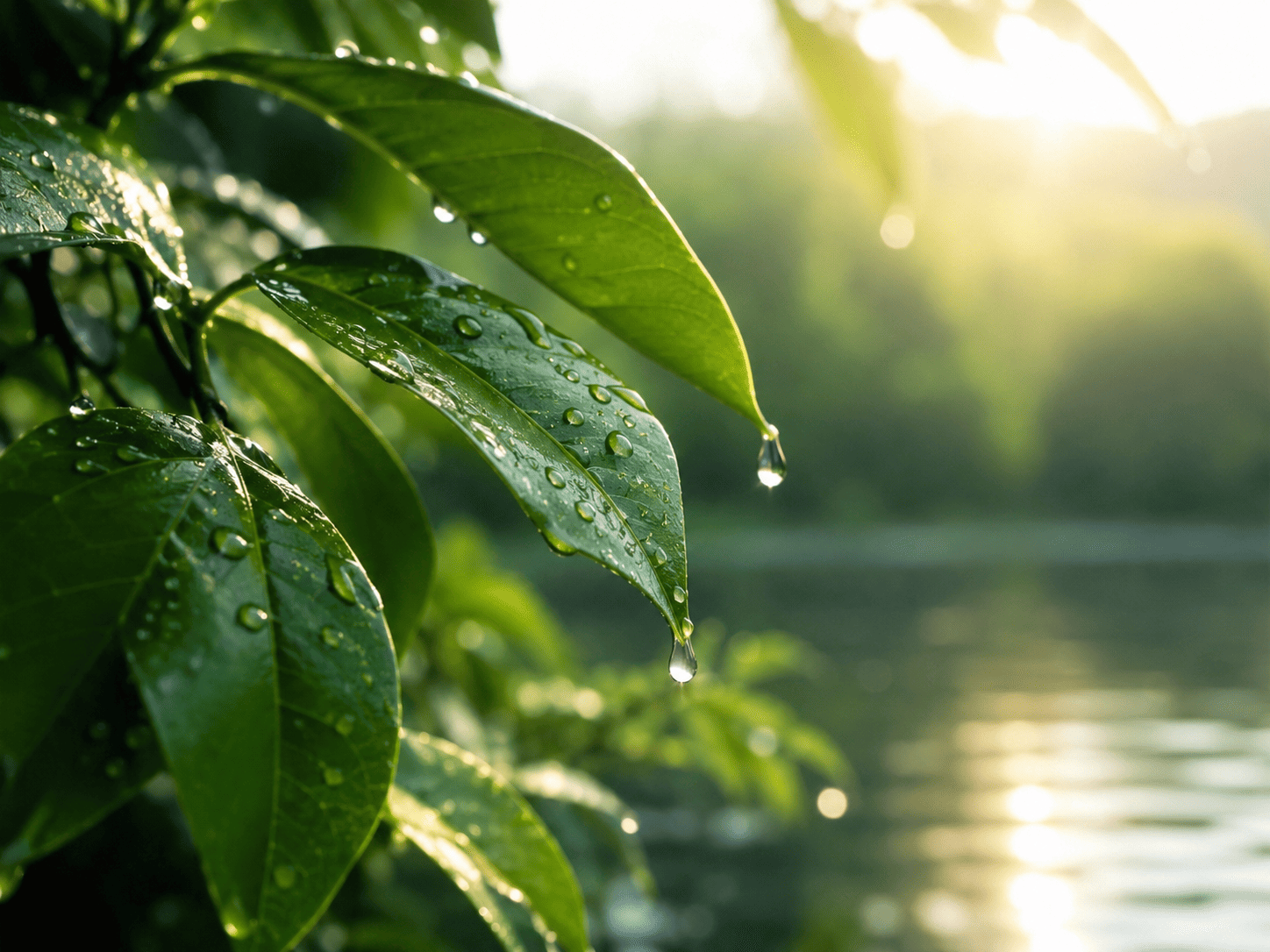
The water we drink is not new matter. It circulates between the atmosphere, soils, groundwater, rivers, oceans and living beings. We extract it, treat it, move it, then return it to the great cycle. Understanding this journey also helps explain why a planet covered in water can nevertheless experience shortages.
The starting point
The bottle on the table
There it is, ordinary, sitting between two cups. Spring water, the kind we drink every day without giving it a thought. And yet that water has a story — a real, long one, far more dizzying than its label suggests.
Before it was bottled, it was groundwater. Before it reached the underground, it was rain. Before it was rain, it was cloud. Before it was cloud, it was vapour rising from an ocean, a lake, damp soil or simply a forest on a hot day.
And before that still, the matter from which it is made was already circulating elsewhere, in other forms.
So what we hold in this bottle is not new water. It is water passing through. To understand where it really comes from is to agree to trace a circuit that most of us have never taken the time to follow all the way back.
Beneath our feet
Beneath our feet, a world full of water
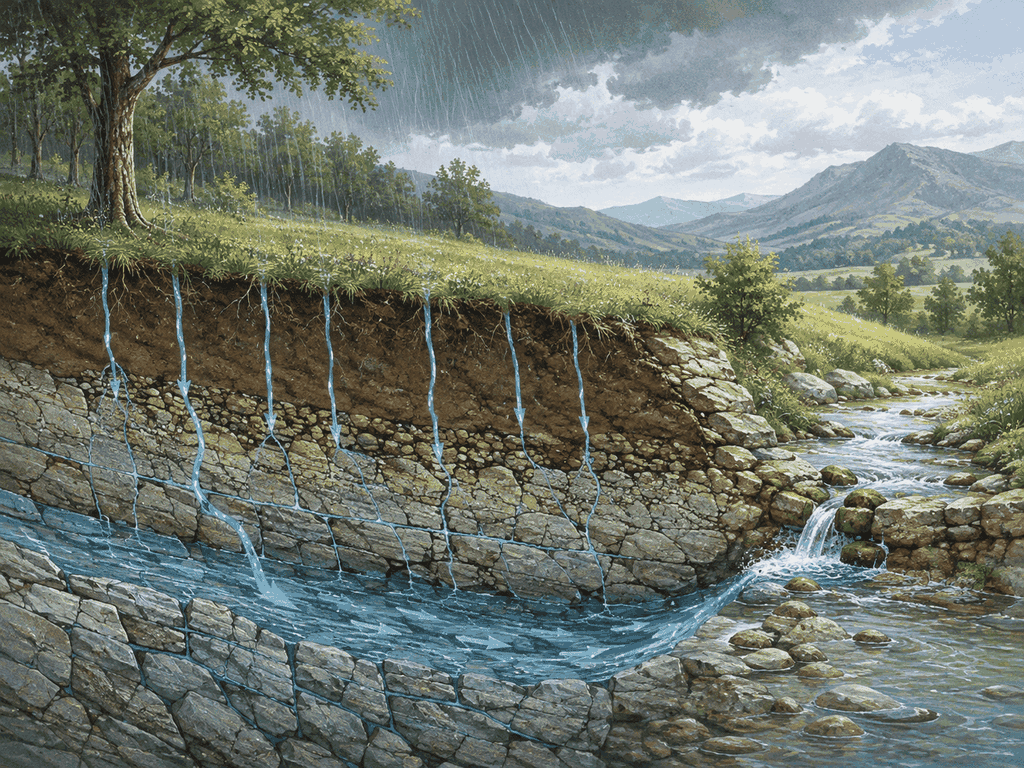
We readily imagine fresh water as something that flows on the surface — rivers, lakes, fountains. In reality, an immense quantity of fresh water lies beneath our feet.
When rain falls, some runs off, some evaporates and some is absorbed by plants. The rest can slowly infiltrate through the soil and then the rock.
When it reaches permeable layers whose pores and cracks can fill with water, it feeds groundwater. This is usually neither a hidden river nor an enormous cave full of water, but sand, gravel or fractured rock whose spaces are saturated — rather like a gigantic mineral sponge buried underground.
A water table is more precisely the upper surface of an unconfined groundwater body, corresponding to the top of the saturated zone.
About 30% of the Earth’s fresh water lies underground, in groundwater and aquifers. The largest share — nearly 69% — is locked up in glaciers and ice caps. Lakes and rivers represent only a tiny fraction.
Some groundwater is quickly renewed by rainfall. Other groundwater circulates very slowly and can remain isolated for thousands, even millions, of years. The term fossil water is sometimes used when it was stored under ancient climatic conditions and is barely renewed today.
A spring, meanwhile, is not the mysterious origin of this water. It is the place where an underground flow naturally meets the surface.
III. Is a spring necessarily safe to drink from?
No. And this is probably one of the most persistent misconceptions.
Spring water can pass through contaminated soils, receive nitrates from agriculture, dissolve certain substances naturally present in rocks, or become contaminated by micro-organisms when its surroundings are poorly protected.
Nature filters a great deal. Soil can retain some particles and certain micro-organisms. But it is neither a treatment plant nor an absolute health guarantee.
This is why a wild spring, however clear and cool it may be, should not automatically be considered safe to drink.
The transparency of water proves nothing. Some dangerous contamination is completely invisible, tasteless and odourless.
Tap water is analysed and, depending on its origin, treated appropriately before distribution. Bottled water is also subject to specific health requirements.
So clear water can be unfit for consumption. And perfectly safe drinking water can naturally contain minerals that give it a particular taste.
IV. What water carries with it
As it descends underground, water does more than travel. It interacts with the rock.
Rainwater is naturally slightly acidic, notably because it contains dissolved carbon dioxide. As it passes through soil and then geological formations, it can dissolve small quantities of the substances it encounters: calcium, magnesium, bicarbonates, sulphates, sodium, silica and many others.
This is why two groundwater bodies in different regions can produce waters with very different compositions.
Water that has travelled through limestone readily picks up calcium and bicarbonates. Water that has crossed volcanic, granitic or sandstone rocks has a completely different identity.
Each water therefore retains a kind of geological signature from its underground journey.
V. Spring water and natural mineral water: a distinction worth knowing
Both come from underground. But they do not meet exactly the same definitions.
Spring water is groundwater that is naturally suitable for human consumption, protected against pollution risks and bottled at source. In particular, it must meet microbiological and health requirements.
Natural mineral water is also of underground origin and protected. But it is distinguished in particular by the stability of its essential characteristics, including its mineral composition.
The word “mineral” also holds a small surprise: it does not necessarily mean “very rich in minerals”.
There are natural mineral waters with very low mineral content.
“Mineral” therefore refers first and foremost to groundwater recognised for its origin and stable characteristics — not necessarily water heavily loaded with calcium, magnesium or various salts.
VI. Why is the water in some regions so hard?
Because water does not pass through the same rocks everywhere.
Water hardness depends mainly on its calcium and magnesium content. It therefore largely reflects the geology of the ground it has crossed.
In a limestone region, water gradually dissolves compounds containing calcium and becomes “harder”. Elsewhere, in ground that releases much less of it, the water remains softer.
This is why two French towns, both supplied with perfectly safe drinking water, can behave very differently in a kettle: one scales up quickly, the other hardly at all.
The white deposit left by hard water is not pollution. It consists mainly of calcium carbonate, which precipitates more readily when water is heated.
Hard water is not considered dangerous to health. Its main drawback is domestic: it causes scale in water heaters, heating elements, taps and small household appliances.
Limescale is chiefly the enemy of the coffee machine, much less so of the person drinking the coffee.
From the home to the river
After you flush the toilet, where does the water go?
It leaves the house through the wastewater pipes.
When a home is connected to the public sewer system, wastewater enters the sewer network and then converges on a wastewater treatment plant, still often referred to as a sewage treatment plant.
This journey is generally invisible, underground and silent.
Yet every shower, every load of laundry, every washing-up session and every flush joins this collective flow, which must be treated before the water is returned to the natural environment.
In areas not connected to the public sewer network, homes have an individual wastewater treatment system that performs this function on a much smaller scale.
VIII. How a wastewater treatment plant cleans our water
The principle is fascinating: a treatment plant reproduces and accelerates certain natural processes of separation and breakdown of matter.
Processes vary between facilities, but several stages are generally found.
Pre-treatment.
Grilles trap large waste. Sand is separated out, along with some fats and oils.
Settlement.
In some plants, the heaviest suspended matter settles.
Biological treatment.
This is the heart of many modern plants. Communities of micro-organisms use part of the organic matter contained in wastewater as food and to grow.
So we entrust a large part of wastewater treatment to microscopic living beings.
Clarification.
The water is then separated from the biological sludge.
Additional treatment.
Depending on the needs of the receiving environment, nitrogen or phosphorus may also be reduced, the water filtered further, or disinfection carried out.
Once treated, this water has generally not become drinking water. It has been sufficiently purified to be discharged into the natural environment in accordance with precise standards.
The sludge produced follows its own treatment route. Depending on its quality and the applicable regulations, it may notably be recovered, anaerobically digested, composted or disposed of.
The great cycle
Then it begins its journey again
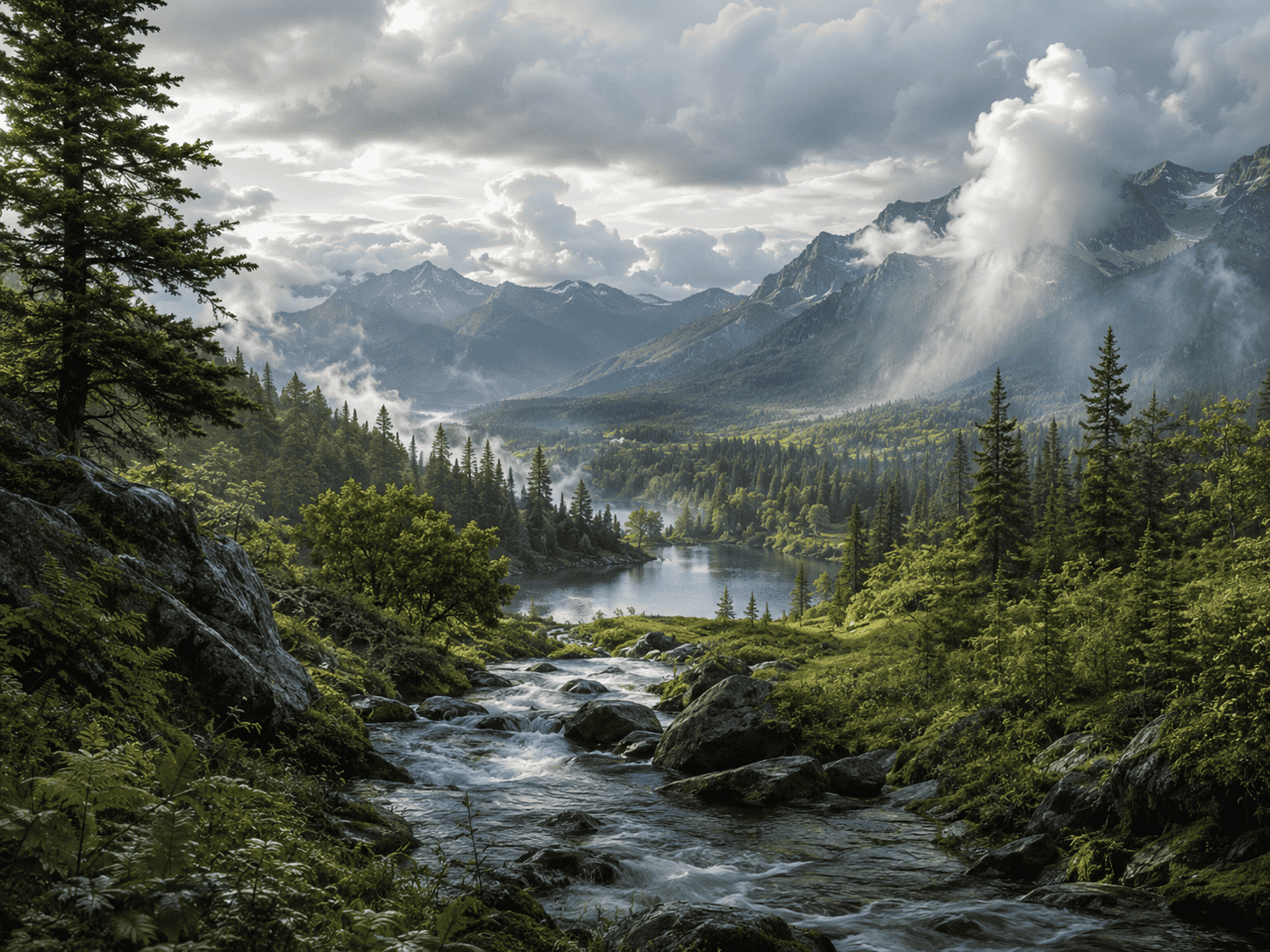
Discharged into a river, the water resumes its place in the great cycle.
It may join a larger river and then the ocean. But it may also evaporate long before that, infiltrate soil, be absorbed by a plant or return to groundwater.
Under the effect of solar energy, water evaporates from oceans, lakes, soils and vegetation. The vapour rises into the atmosphere, cools and condenses into tiny droplets or crystals.
Clouds move.
Then the water falls again as rain, snow or hail.
Some returns directly to the sea. Some falls over the continents, feeding soils, plants, rivers and groundwater.
And the journey begins again.
This is the water cycle: not a neat little loop, but a vast network of routes, storage and returns, whose timescales can range from a few hours in the atmosphere to millennia in certain groundwater bodies or ice.
X. Is the Earth a closed jar?
Almost.
And that is precisely what makes this story so dizzying.
The Earth contains about 1.4 billion cubic kilometres of water. On the scale of a human lifetime, or even of a civilisation, this total quantity changes very little.
Water mainly changes place and state: liquid in the ocean, solid in a glacier, gaseous in the atmosphere, trapped in soil, groundwater, a plant or an animal.
But the planet is not perfectly sealed.
Over very long timescales, a small amount of matter can escape into space. Tiny inputs also arrive from extraterrestrial material. And on geological timescales, water circulates between the Earth’s surface and its depths: some mantle rocks contain water, while volcanism returns some of it to the surface.
So the Earth is not quite a closed jar.
But on our scale, it resembles one very closely.
When water runs short
So why do we talk about water shortages?
Here is the paradox: if water does not disappear, how can we run short of it?
Because all this water is not fresh, accessible, clean or available where we need it.
About 97.5% of the Earth’s water is salty.
Fresh water accounts for only about 2.5% of the total. And within that fresh water, nearly 69% is stored in glaciers and ice caps, while about 30% lies underground.
That leaves only a very small share in lakes, rivers, soils, the atmosphere and other surface reservoirs.
But even that picture is not enough. Some groundwater is difficult to reach, too deep, too slow to renew, or located far from the populations that need it.
So the real question is not:
“Is there still water on Earth?”
The answer will remain yes for a very long time.
The right question is:
“Do we have fresh water of sufficient quality, in sufficient quantity, in the right place and at the right time?”
That is where shortages begin.
They are made worse by over-extraction from groundwater, pollution, soil sealing, the destruction of wetlands, certain agricultural practices, increasing demand and climate change, which alters rainfall patterns and evaporation.
A water shortage is therefore not the disappearance of the Earth’s water.
It is a crisis of availability.
Human ingenuity
Human beings do more than look for springs
Throughout history, human societies have invented remarkable ways to find water wherever it is hidden.
Collecting rainwater
It is one of the oldest methods.
A roof or prepared surface receives the rain, which is directed into a cistern.
In France, domestic use of rainwater and, more broadly, water not intended for human consumption is now precisely regulated. Certain uses are permitted under conditions, such as watering, toilet flushing, cleaning certain surfaces and, subject to particular requirements, some other uses.
However, water collected in this way is not something one can simply decide to drink because it “comes from the sky”. Uses involving drinking and food preparation are subject to much stricter health requirements.
And non-potable water networks must remain separate from the network supplying water intended for human consumption.
Digging down to groundwater
Wells and boreholes make it possible to reach groundwater.
Some civilisations went much further.
Qanats, developed since Antiquity notably in Persia, use long, gently sloping galleries to carry groundwater from upland areas towards villages and crops.
No pump is needed.
Only gravity, remarkable knowledge of the terrain and considerable human labour.
Catching fog with nets
It sounds almost unreal.
Yet it works.
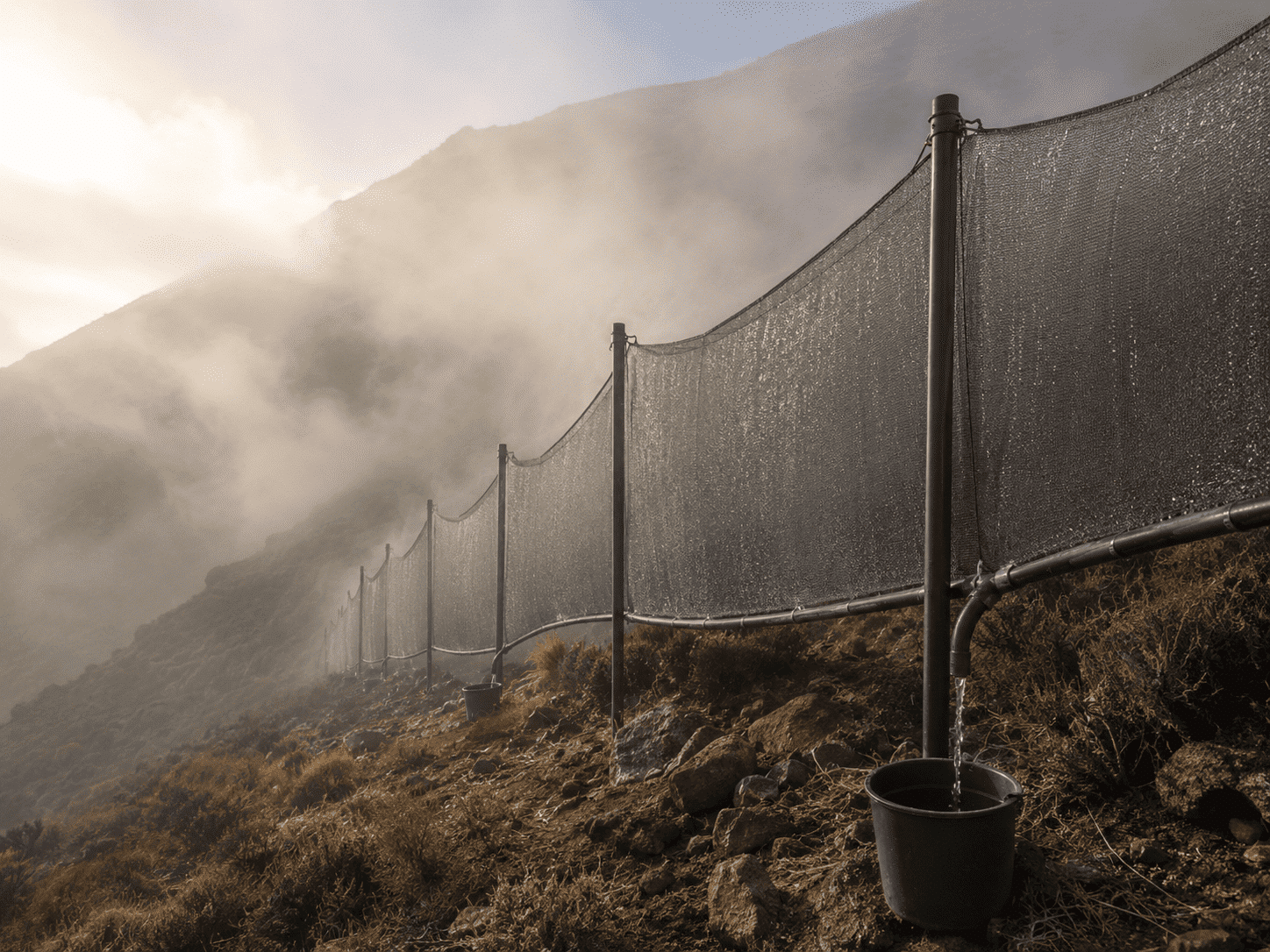
In some mountainous or coastal regions where fog is frequent, large nets are installed facing the wind. Tiny droplets suspended in the air cling to the mesh, merge, become heavier, run down into a gutter and are then carried into storage tanks.
In Morocco’s Anti-Atlas, on Mount Boutmezguida, 31 CloudFisher collectors representing about 1,686 m² of mesh have been installed.
On a favourable foggy day, the system can collect around 37,000 litres of water.
The installation supplies several villages in the Aït Baamrane region. The project notably brings together the local Dar Si Hmad foundation and the organisations behind the CloudFisher system.
Here, nobody digs to find water.
They harvest it from the cloud.
Collecting dew
The principle is different.
On some nights, a surface can lose enough heat to become colder than the surrounding air. When its temperature falls below the dew point, some of the atmospheric water vapour condenses on it.
Surfaces can therefore be designed to encourage this condensation and allow the resulting water to be collected.
Even without rain, the atmosphere contains water.
XIII. Can we drink the sea?
Yes.
But first, most of its salt has to be removed.
This is the principle of desalination.
The most widely used technology today is reverse osmosis. Seawater is put under high pressure and forced against membranes that allow much of the water through while retaining most of the dissolved salts.
For seawater, the pressures used can commonly reach around 60 to 80 bar.
The reverse-osmosis stage itself requires a great deal of energy. In a large modern plant, it may account for around 2.5 kWh per cubic metre produced. If pumping, pre-treatment, remineralisation, brine disposal and the other stages of the process are added, a large efficient plant is more likely to be around 4 kWh per cubic metre, with significant variation from one site to another.
Desalination therefore genuinely turns the sea into a source of fresh water.
But this solution comes at a cost.
It requires energy and produces brine, water with a much higher salt concentration, which must be returned to the marine environment without causing significant harm to ecosystems.
Desalination is a valuable resource for some territories.
It is not a magic wand.
XIV. What does “filtered water” mean?
The term sounds simple.
Yet it covers very different processes.
And each system removes only what it was designed to remove.
Activated carbon
Used notably in some filter jugs, it can reduce chlorine responsible for tastes or odours and retain certain compounds.
But it is not designed automatically to turn contaminated water into drinking water.
And a poorly maintained filter can itself become a place where microbes develop.
Mechanical filtration
It traps particles according to their size.
The finer the pores, the smaller the particles that can be retained. But many salts and dissolved substances pass through ordinary mechanical filtration.
Ultraviolet treatment
It can inactivate many micro-organisms.
But it removes neither limescale, nor salt, nor metals, nor most dissolved chemical substances.
Reverse osmosis
It removes a very large proportion of salts and many dissolved substances.
It is a powerful technique, but it substantially changes the water’s mineral composition and also produces a concentrated waste stream.
Water softeners
A softener is not really a filter.
A resin exchanges, in particular, calcium and magnesium ions for other ions, most often sodium. Its main purpose is to limit limescale in installations.
So asking:
“Is this water filtered?”
is not enough.
The real question is:
“Filtered by what — and to remove what?”
XV. One last strangeness
We have invented pumps to draw water from underground.
Dams to hold it back.
Plants to clean it.
Membranes capable of desalinating the ocean.
Nets capable of harvesting fog.
Surfaces capable of collecting dew.
And yet, despite all this technology, our civilisation remains subject to an elementary rule that already applied to the first humans:
we create almost none of the water we need.
We search for what already exists.
We extract it.
We move it.
We store it.
We treat it.
We desalinate it.
Sometimes we reuse it.
Then, sooner or later, we return it to the great cycle.
A very ancient substance
Is the water you drink older than you?
Infinitely older.
But we need to be precise about what that means.
The matter water is made of — hydrogen and oxygen — obviously predates our existence by an immense margin. Some of the Earth’s water itself may have been inherited from the very earliest stages of the formation of the Solar System.
Astrochemistry work by Cecilia Ceccarelli and Fujun Du suggests that a significant fraction of the water present on Earth today may come from ice formed very early, before or during the birth of the Solar System, around 4.5 billion years ago.
It would then have been incorporated into the materials from which planets, asteroids and comets were built.
But it would be misleading to imagine every H₂O molecule as a tiny bead that has remained intact for 4.5 billion years.
Water is constantly involved in chemical and biological reactions. Molecules are split apart and re-formed. Their atoms change partners.
What therefore survives through the ages is less the identity of a particular molecule than the matter of water, continually recombined and set back into circulation.
And that does not make the story any less extraordinary.
Quite the opposite.
The atoms in your glass today began their journey long before the first river, the first tree and the first animal on our planet.
XVII. Water that has already lived a thousand lives
Here is the ending.
And perhaps the most beautiful idea in this whole dossier.
The matter that makes up the water in your glass has been stirred, moved and recombined over timescales that almost exceed our imagination.
Some of it may have spent time in a glacier.
Fallen as rain on a forest that no longer exists.
Passed through soil on which prehistoric animals once walked.
Joined a river.
Been absorbed by a plant.
Passed through the body of an animal or a human being.
Returned to the atmosphere.
Then started again.
Of course, we will never be able to reconstruct the individual route of the atoms contained in a glass of water.
But with astronomical numbers of molecules, several billion years of circulation and a planetary cycle that continually mixes its reservoirs, the idea that the matter in our water has already crossed paths with countless forms of life is not fanciful at all.
Drinking a glass of water therefore never means receiving something truly new.
It means welcoming, for a few hours, matter that was circulating long before us and that will continue its journey after us.
Towards other soils.
Other rivers.
Other clouds.
Other lives.
Perhaps, deep down, that is everything Les Chevaliers de l’Astrée are trying to help us perceive:
that nothing around us is ever entirely new, nor entirely ours.
We merely receive it for a while.
It is up to us to care for it.
It is up to us to protect it.
And to pass it on to what comes after.
Key points
- Earth’s water continually circulates between the atmosphere, soils, groundwater, rivers, oceans and living beings.
- Clear water or a natural spring is not automatically safe to drink.
- Water scarcity is mainly a crisis of access to fresh, clean water in the right place and at the right time.
- Treatment, desalination, rainwater harvesting and fog collection can all help us use water differently, but no solution is without limits.
- The matter in the water we drink is immensely ancient and will continue circulating after us.
Frequently asked questions
What people often ask about water
Is a natural spring always safe to drink from?
No. Water can be crystal clear and still contain invisible micro-organisms or substances. Potability cannot be judged by sight or taste.
Does the Earth’s water eventually disappear?
At our scale, very little does. Water mainly changes place and state within the great water cycle. The difficulty lies in access and quality, not in a general disappearance.
Why can water be scarce on a planet covered in oceans?
Because the vast majority of the Earth’s water is salty, and a large share of fresh water is stored in ice or underground. The easily accessible fraction is very small.
Is filtered water always safe to drink?
No. It depends on the process used and what it is capable of removing. Filtering, disinfecting, softening and desalinating are different operations.
The Astrée perspective
Water never truly belongs to us. It passes through our glasses, our homes, our soils and our bodies, then continues on its way. We receive it only for a while.
Sources and reference points
- U.S. Geological Survey (USGS), Water Science School: distribution of the Earth’s water, groundwater, aquifers and the water cycle.
- European Commission: regulation and characteristics of natural mineral waters and spring waters.
- Légifrance: French Public Health Code and French regulations on water not fit for human consumption for domestic uses.
- WasserStiftung / CloudFisher and Dar Si Hmad: fog-water collection project on Mount Boutmezguida, Morocco.
- French Ministry for the Ecological Transition, report Potential and limits of seawater desalination development in France, 2025.
- Cecilia Ceccarelli and Fujun Du, We Drink Good 4.5-Billion-Year-Old Water, 2022.
Your voice matters
Respond to this Echo
An observation, experience or question? Share it here. Comments are reviewed before publication.
No published comments yet. You can start the conversation.