Echoes of the Living World · Water and farming
France and Spain face the challenges of crop and livestock farming
Feature reviewed and updated on 15 October 2026
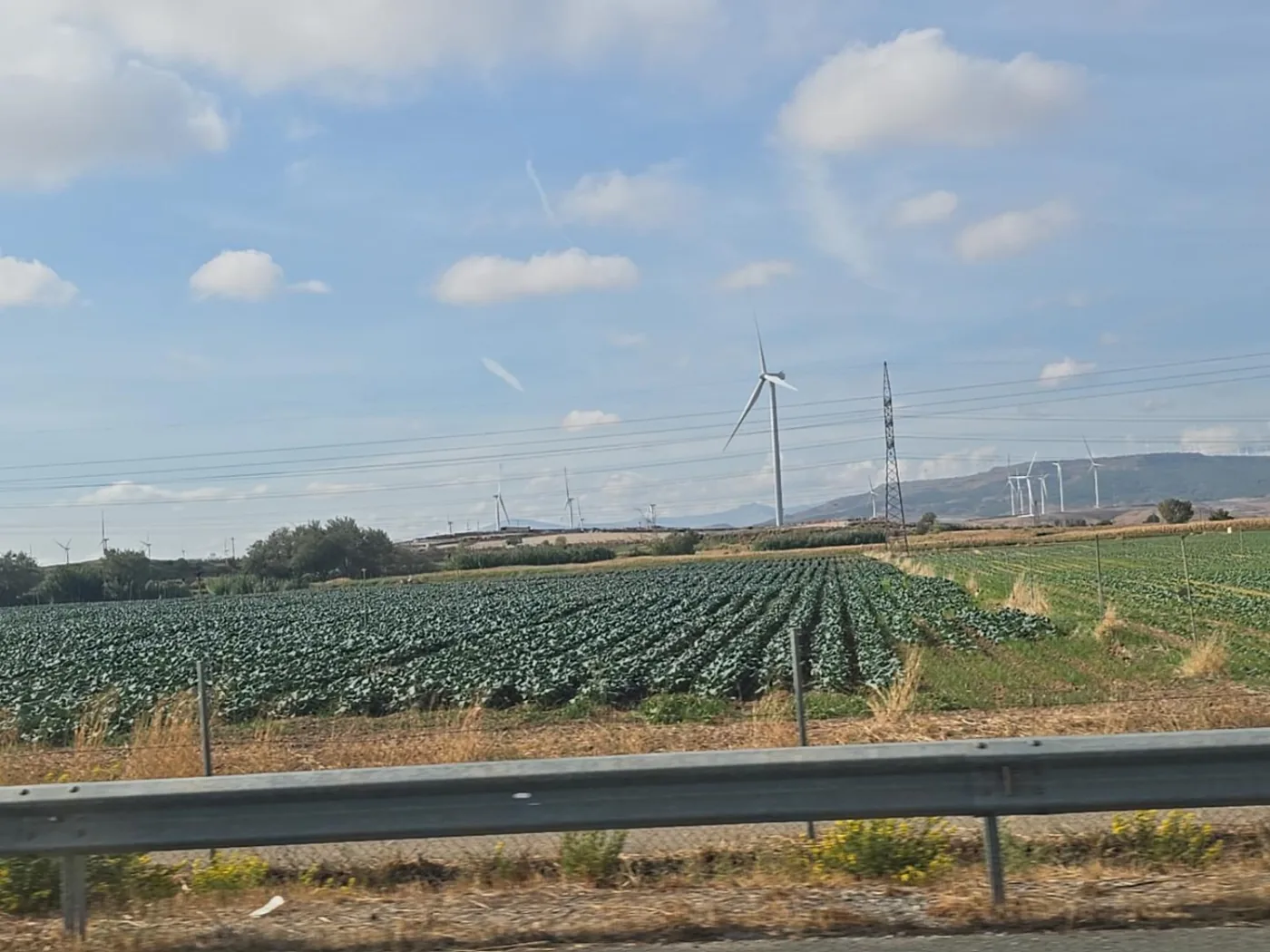
From a Spanish road, a green field sometimes stands out against the dry hills. A few pipes appear, upright risers emerge above the crops, then the network disappears underground. Where does this water come from? Who shares it? And what happens to the fields that depend entirely on rain?
These questions travelled with us during our journey through Spain. They open this feature: from the gardens of the Alhambra to the rice fields of the Ebro, then on to French grasslands, let us follow the water that feeds the land and its herds.
In a minute
The challenge is to farm with water available in the right place and at the right time, while protecting the ecosystems that depend on it. Canals, storage reservoirs, drip irrigation and reclaimed water can help. Their value depends on soils, crops, climate and the rules for sharing water. Grasslands and animals are an integral part of this story.
A summer that brings the challenge into focus
Météo-France ranks summer 2026 as the warmest recorded in France since 1900, with an average temperature of 24 °C. This is a national average across the season’s days and nights, not a maximum temperature. [1]
As of 30 September 2026, Agreste estimates cumulative permanent grassland growth at 42% below the 1989–2018 reference for the same date. This national figure does not describe every grassland, but it makes the difficulties facing livestock farms visible. [2]
Spain and the paths of water
Spain is not uniformly arid. But in its dry regions, bringing water to crops has profoundly shaped the landscape. The canals visible from the road tell an ancient story; buried pipes continue that work today.
At the Alhambra, a river enters the gardens
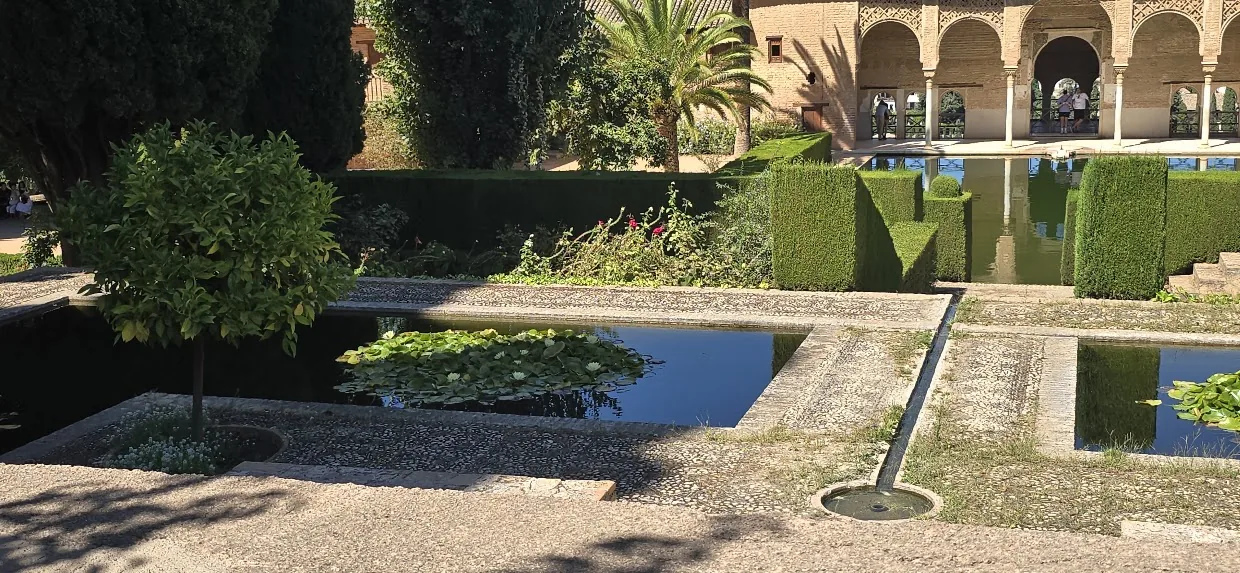
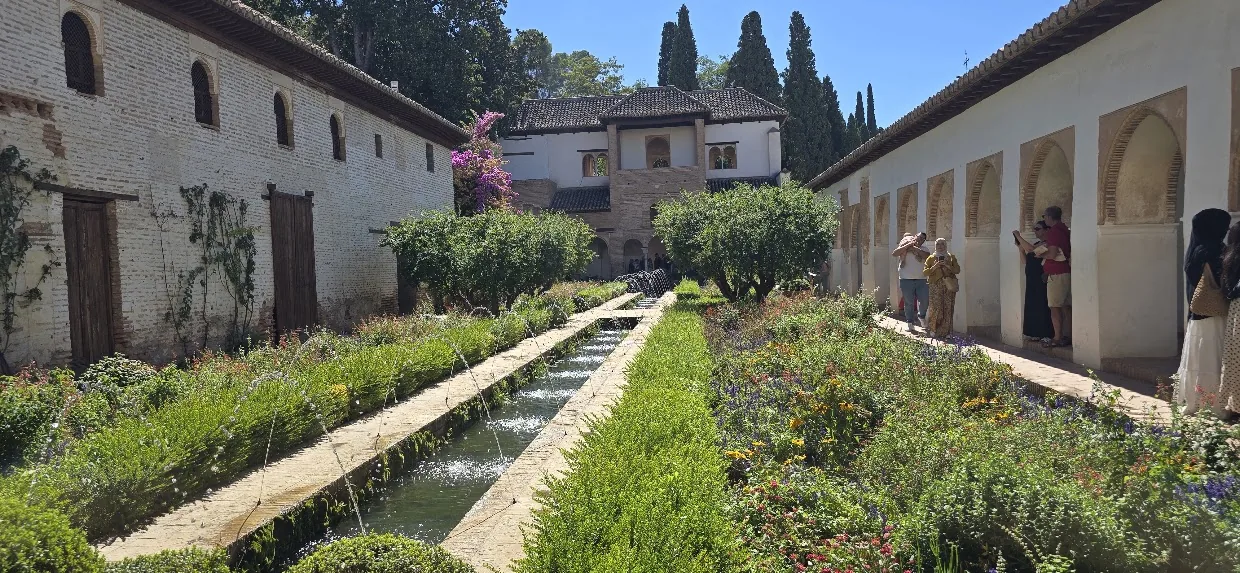
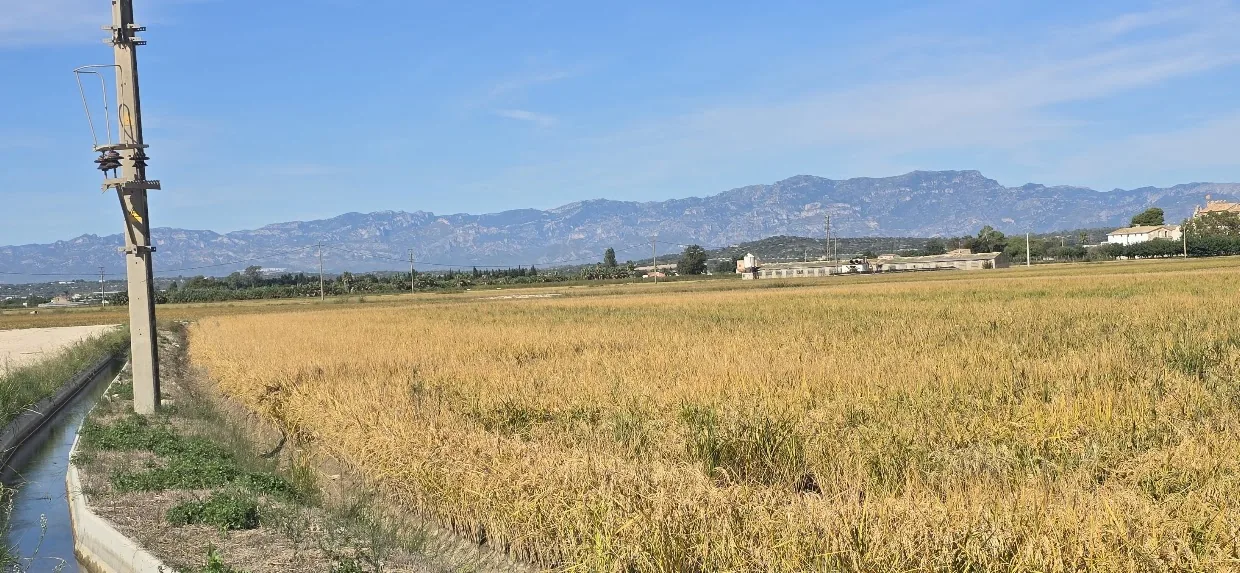
In Granada, fountains and pools seem to be a natural part of the palace. Yet their presence rests on a precise decision: divert water from the Darro upstream, at a higher elevation, then carry it along a gently sloping canal to the Generalife and the Alhambra. Gravity moved the water. [5]
The Acequia Real is a reminder that successful irrigation begins long before the roots. It requires an intake, a route, distribution and maintenance. The Spanish word acequia refers to these canals, still found in irrigated landscapes.
From vast structures to discreet networks
The Canal Imperial de Aragón follows the Ebro for around 108 kilometres. Its intakes supply irrigation communities and crops such as alfalfa, maize and cereals, as well as fruit and vegetables in some areas. The canal also serves other purposes, including water supply. [6]
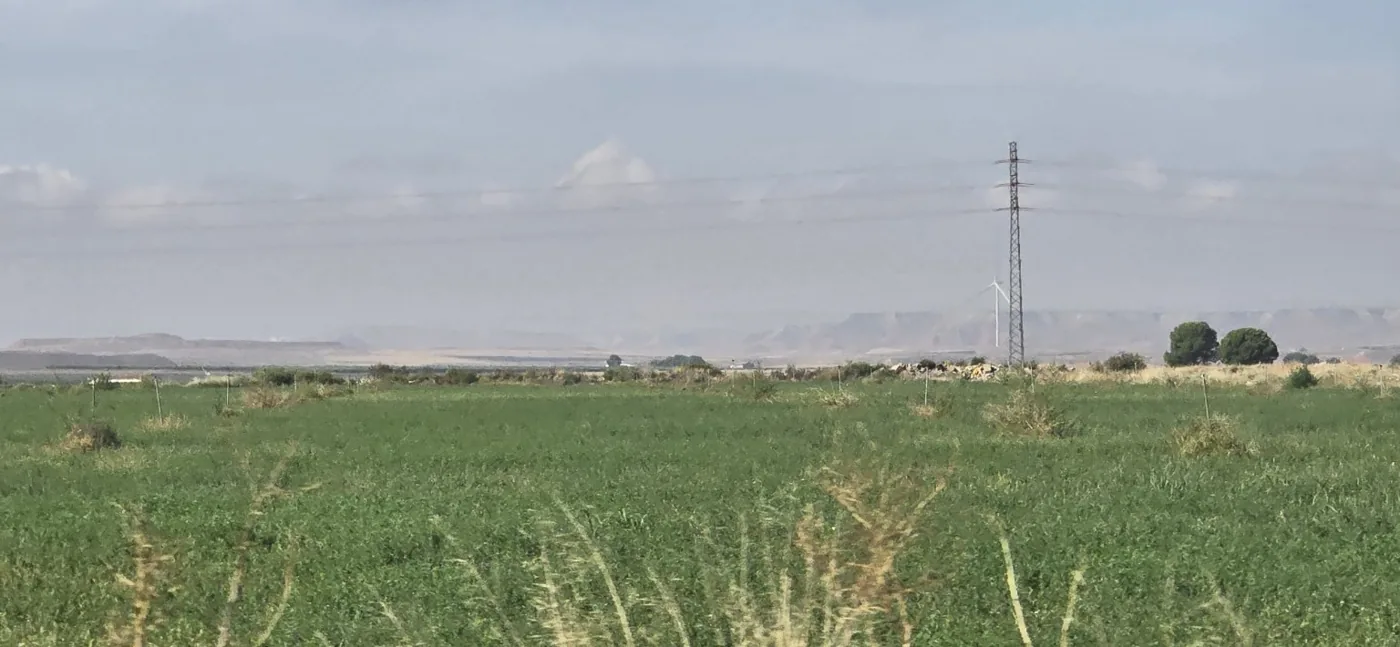
Within a field, the network can become almost invisible: a buried pipe leads to a hydrant, then to irrigation equipment. Valves and meters organise distribution. A field with no visible pipes may therefore still be irrigated.
| What we can observe | How water reaches the plants |
|---|---|
| Furrows or a flooded field | Gravity flow shaped by the slope and field layout. |
| Risers and water jets | Sprinkling above the crops. |
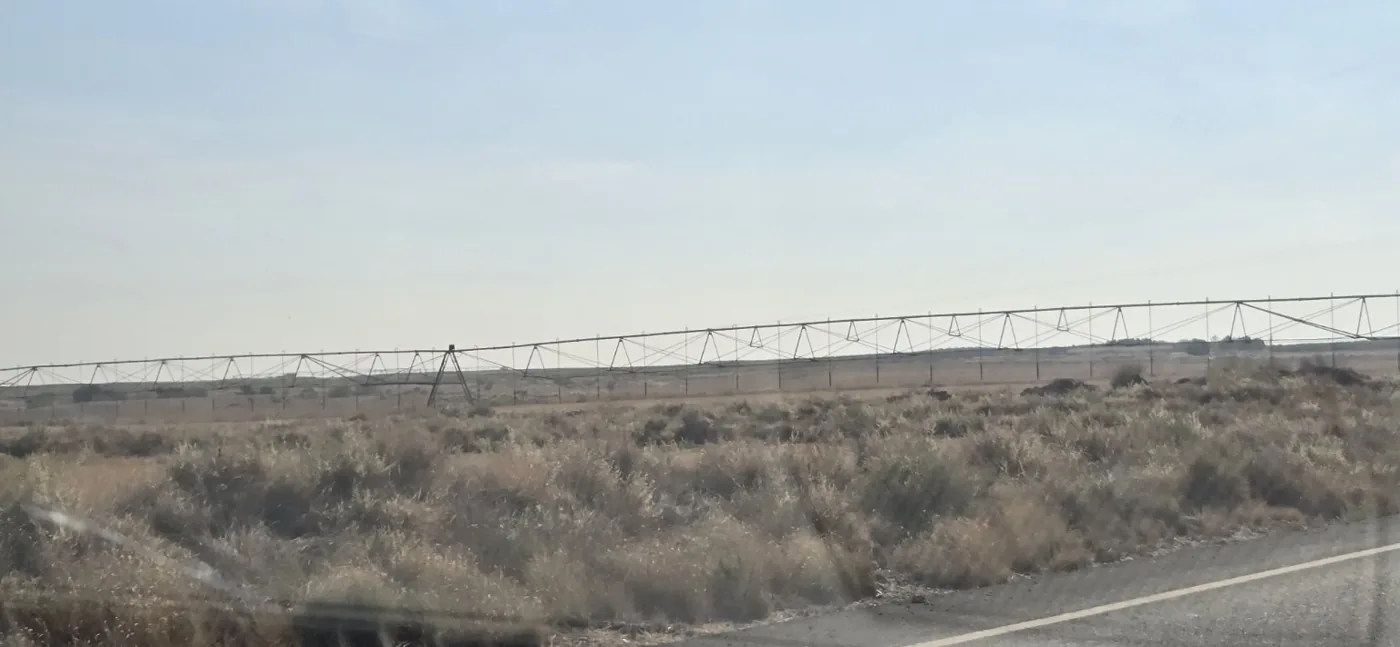
| A long moving irrigation boom | Sprinkling; a centre pivot rotates around a fixed point. |
| Pipes at the base of the plants | Drippers deliver water locally. |
And those intriguing stakes? Without a visible sprinkler head or connection, we cannot be sure: they could also be plant supports, markers or stakes. A close-up photograph is better than a certainty formed at 80 km/h.
The techniques share the same aim: supplying an amount suited to the crop. Management matters as much as equipment; even efficient equipment can apply too much water, or apply it at the wrong time. [14]
From the Ebro to the sea
Rice between fresh water and salt
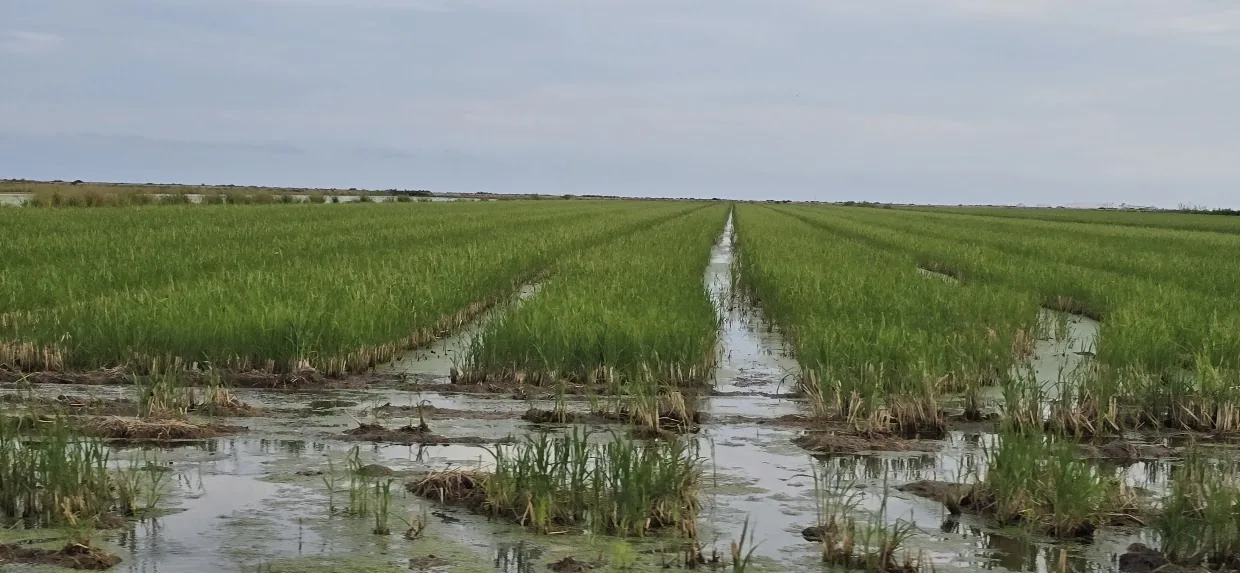
Towards the mouth of the Ebro, rice fields give the landscape its distinctive rhythm. Water nourishes the rice, but it also plays a part in managing salt. Reducing inputs without considering the soil can increase salinity and put the crop at risk.
IRTA, the Catalan agrifood research institute, is studying precisely this balance in the delta: different irrigation methods are being compared while monitoring salinity, weeds and yield. A water saving that looks promising on paper still has to work in the field. [7]
Reserves that do not reach every field
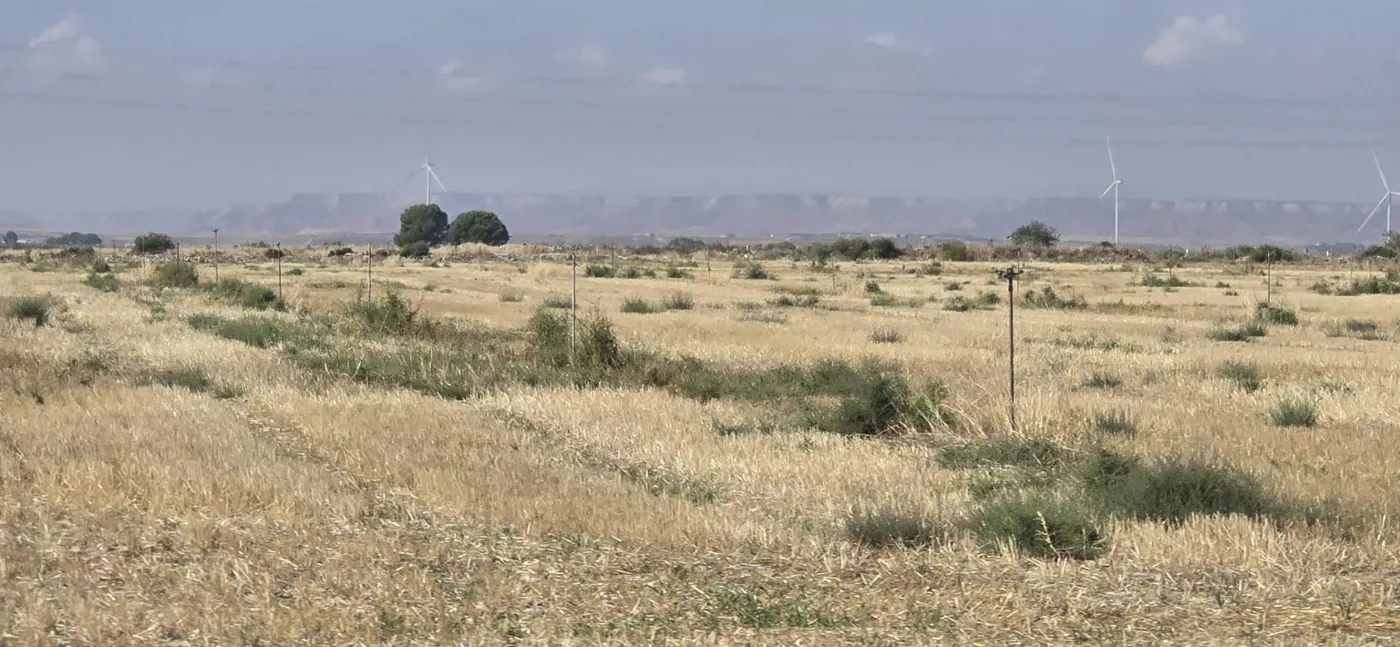
A full reservoir does not mean that every farmer has water. There must be a network, access to the resource and rules allowing its use. Land farmed as secano, without irrigation, remains dependent on rainfall. National storage figures alone cannot describe conditions in an orchard or a pasture.
Spain’s Ministry of Agriculture (MAPA) describes irrigation as covering around 22% of cultivated land and producing 71% of the value of crop production. These overview figures, published in 2025, measure its economic importance; they do not mean that irrigation produces 71% of all Spanish food. [4]
Desalinating seawater and reusing treated water
In some Spanish regions, desalinated seawater supplements agricultural water supplies. Desalination separates less saline water from a concentrated discharge, known as brine. It requires energy, infrastructure and careful management of discharges. MITECO identifies improving these processes as a technical and environmental challenge. [8]
Another approach is to reuse wastewater after suitable treatment. Its quality must match the crop and the irrigation method. Investment goes beyond treatment: the water must also be carried to the fields. [9]
Something to keep in mind. Reusing water can replace an existing withdrawal. If the extra supply mainly creates new demand, the benefit to water resources becomes less certain. INRAE calls this a rebound effect. [9]
France and the debate over water storage
In France, much of agriculture relies on rainfall and water stored in the soil. This makes crops and grasslands sensitive to the succession of seasons: a wet winter does not guarantee a trouble-free summer.
Needs vary widely between areas
In 2023, around 1.5 million hectares were actually irrigated in mainland France, accounting for 5.7% of utilised agricultural area. More land is equipped for irrigation: land that can be irrigated and land actually irrigated are not the same thing. [3]
This national rate conceals large differences between regions and crops. Irrigation can be crucial for an orchard, vegetables or seed production, even when it covers only a small share of the country’s farmland. [3]
Storing water for summer
Depending on its design, a reservoir may collect runoff or be supplied from a watercourse or by pumping. A so-called substitution reservoir aims to shift withdrawals to a period when water is considered more available, reducing those made during the dry season.
Its value therefore depends on filling conditions and how the river basin functions. Reservoirs can alter flows and aquatic ecosystems; their cumulative effects also need to be studied. Once built, a reservoir still has to be able to fill sustainably. [10]
Debates over France’s large agricultural storage basins, often called “mégabassines”, benefit from returning to practical questions: where does the water come from, when is it withdrawn, who has access to it, and what commitments govern its use?
Compare without confusing
| Reference point | Spain | France |
|---|---|---|
| Reported area | Around 22% of cultivated land | 5.7% of utilised agricultural area in 2023 |
| Data context | MAPA communication from 2025 | Agreste statistical survey |
| Key point | Irrigation plays a major role in crop production | Irrigation is concentrated in particular crops and regions |
Mind the denominators. Spain’s cultivated area and France’s utilised agricultural area do not cover the same categories of land. These percentages help explain the two situations; they cannot be used directly to conclude that one country irrigates “four times more” than the other. [3–4]
The water that feeds the herds
A cow depends on the water it drinks, but also on the water that grows its food. When grass stops growing, drought enters livestock farming through two doors at once: the drinking trough and the feed ration.
When winter begins in summer’s feed stores
As of 30 September 2026, cumulative growth of French permanent grassland was 42% below the 1989–2018 reference period for the same date. The Agreste dashboard was published on 7 October. [2]
This figure concerns grass growth. It measures neither a 42% fall in cattle numbers nor an identical loss on every farm.
For an affected farm, less grass may mean less grazing and hay, additional purchases or early use of winter reserves. Difficulties can therefore continue after rain returns: stores that have been used must be replenished.
Heat also affects animals directly
Drinking-water needs increase in hot weather, just when supplies may be at their lowest. Water availability and quality, and access to troughs for every animal, become essential. [11]
In dairy cows, research from the CAICalor programme documents the effects of heat stress on production and reproduction. Shade, grazing arrangements and building ventilation are among the possible adaptations, to be assessed for each farm. [12, 19]
Livestock farms face different kinds of exposure
A grazing herd depends directly on available grass. A farm buying much of its feed may be affected by supply difficulties and feed prices, even if its animals do not graze. In both cases, today’s decisions shape the months ahead.
In Spain too, pastures and drinking-water points are part of the equation. Local situations need their own data: the French grassland figure cannot be applied to them.
A different perspective. Behind a yellowing pasture, there is living soil, a herd and someone deciding how to get through the next season.
Farming with drier summers
Start with the soil
Useful rainfall is also rainfall that enters the soil. Cover crops, plant residues, crop rotations and additions of organic matter can protect its surface and improve its structure. These practices must take account of the climate and available water. [13]
Hedges and trees slow some flows, encourage infiltration and modify the microclimate. They also use water: their location and interactions with neighbouring crops matter. A good idea needs the right place. [18]
Choose crops and their timing
Water needs depend on the species, its stage of development and the weather. Growing during a cooler period or choosing a shorter cycle can change the amount of water needed over the season. These choices must remain compatible with the soil, markets and the farm’s other constraints. [17]
Diversifying crops and harvest times can help spread risk. But no variety alone guarantees a harvest in an extreme drought. For a fruit tree, survival and regular fruit production remain two different goals.
Irrigate precisely
Soil-moisture sensors and irrigation management tools help determine when and how much to irrigate. INRAE’s findings show that savings depend on equipment, but also on its settings and operation. Drip irrigation therefore needs to be assessed under real field conditions. [14]
The goal must remain clear across the whole area: reducing pressure on water resources. A saving per hectare can be cancelled out by an increase in irrigated area. [9–10]
Share experience and decide together
Spain has long experience of collective networks and localised irrigation. In France, area-based water management projects seek, among other things, to bring farmers, local authorities and other users together around needs and resources. Neither approach is exclusive to one country. [4, 10]
The shared question is practical: which forms of production can we maintain, with what water, for which uses and at what cost? Answers require local trials, monitoring of withdrawals and water-sharing decisions that everyone can understand.
The walipini through the eyes of l’Astrée
A greenhouse that draws on the soil
A walipini is an underground or partly sunken greenhouse that uses the ground’s thermal inertia to soften temperature changes. The Benson Institute manual, developed for La Paz in Bolivia, describes this way of protecting crops in a particular environment. [15]
The idea deserves attention as a way to extend some vegetable-growing seasons or limit heating needs. Its success nevertheless depends on sunlight, orientation, ventilation and drainage. Wet ground or a nearby water table can make installation difficult. [15]
The winter solar greenhouses studied by the University of Minnesota pursue a similar aim with a different design. They highlight vegetables that tolerate cold and low light. They do not prove that a walipini can produce tomatoes year-round in every climate. [16]
What about water? Plants continue to transpire and the soil continues to lose water. A promise of growing “without watering” requires a water balance: initial moisture, any inputs, crop duration and the harvest obtained. An underground greenhouse does not remove the need to understand plants’ water requirements. [17]
What we want to see differently
For Les Chevaliers de l’Astrée, these questions take a tangible form: a meadow at Les Eaux de Velours, an orchard at Les Mille Légendes, olive and almond trees on Les Terres d’Aragon. These places have different soils and different possibilities for accessing water.
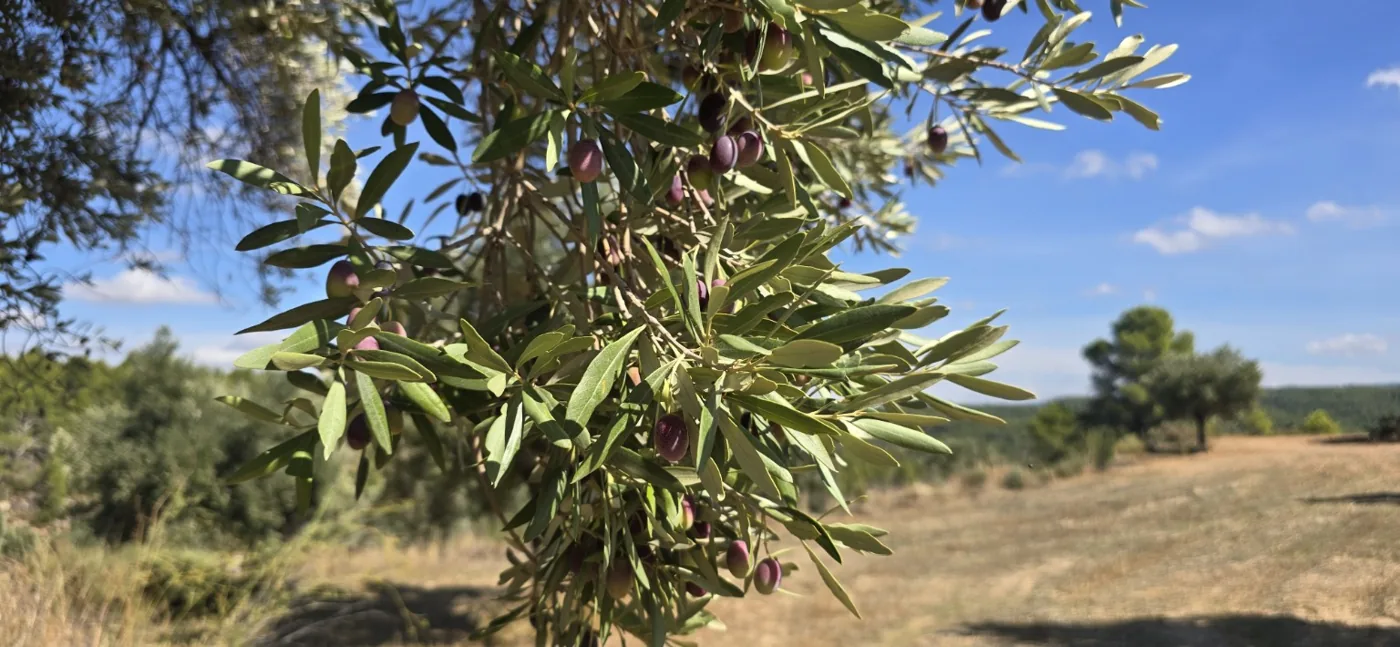
Observing them reminds us that a green landscape does not prove self-sufficiency, and a tree still standing does not necessarily promise a harvest. Before adding a crop or a structure, we need to understand what the place can sustain over time.
A river supports organisms beyond the fields it irrigates. A meadow hosts more creatures than the animals grazing there. Protecting this life must be part of agricultural choices, alongside food, income and the work of those who farm.
The future will also be shaped by patient actions: monitoring soil moisture, keeping a well-placed hedge, trying a crop on a small scale, comparing results. Ingenuity is valuable when it helps us inhabit a place without exhausting what keeps it alive.
Sources and reference points
View the feature’s 19 sources
References consulted for this edition of 15 October 2026. Observation dates are specified in the text. French and Spanish data are presented with their respective scopes.
[1] Météo-France · Bilan climatique de l’été 2026. 3 September 2026.
[2] Agreste · Pousse de l’herbe au 30 septembre 2026. 7 October 2026 · 1989–2018 reference period.
[3] Agreste · GraphAgri 2025 · Irrigation. 2023 survey of farm structures.
[4] MAPA · La modernización de regadíos impulsa una agricultura rentable y competitiva. 2025 press release · overview figures on irrigated farming.
[5] Patronato de la Alhambra y Generalife · La Acequia Real de la Alhambra. Presentation of the historic water network.
[6] Confederación Hidrográfica del Ebro · Canal Imperial de Aragón. Presentation of the canal and its uses.
[7] IRTA · HERBESREG. 2024–2026 project · irrigation and salinity in the Ebro delta’s rice fields.
[8] MITECO · Documento Idiagua. December 2015 · desalination, energy and brine.
[9] INRAE · L’eau, ça se recycle. Feature on wastewater reuse.
[10] INRAE · Irriguer différemment. 3 June 2022 · rainfed farming, reservoirs and water sharing.
[11] Institut de l’élevage · Sécheresse 2023 · L’abreuvement des animaux. 2023 · needs and supply.
[12] Institut de l’élevage · Limiter le coup de chaud des vaches laitières. 15 May 2024 · example of adapting practices and buildings.
[13] INRAE · Comment l’agriculture peut elle s’adapter aux étés de plus en plus secs. 2026 · soils, cover crops, rotations and trees.
[14] INRAE · Irrigation · Un outil pour évaluer et encourager les économies d’eau. 1 February 2018 · equipment and management.
[15] Benson Agriculture and Food Institute · Walipini Construction. 2002 · manual developed for La Paz, copy of the original document.
[16] University of Minnesota Extension · Deep winter greenhouses. Winter solar greenhouses · designs distinct from the Andean walipini.
[17] FAO · Irrigation Water Management · Crop water needs. Crop water requirements, evaporation and transpiration.
[18] INRAE · Des haies bocagères pour le climat et l’environnement. 2020 · water movement and interactions with crops.
[19] Institut de l’élevage and INRAE · Bilan CAICalor. 20 June 2025 · heat stress, production and reproduction.