Echoes of the Living World · Old knowledge and preservation
The grape that refused to grow old
At Thomery, how a village learned to keep autumn alive until spring
In one minute
At Thomery, near Fontainebleau, generations of growers learned to preserve Chasselas grapes long after harvest.
Imagine a village in the middle of winter.
The trees are bare. The gardens are resting. The autumn harvest is already only a memory.
And yet, in a dark room, bunches of grapes are still hanging there, golden and plump.
We are in Thomery, near Fontainebleau.
It is January. Perhaps February.
And some bunches will still be sold in April. Sometimes even in May.
No refrigerator. No plastic. No controlled atmosphere.
Only a few walls, a great deal of observation… and thousands of small bottles of water.
A story
Growing grapes where they were not really at home
Thomery is not Provence. To grow fine table grapes in this climate, growers first had to learn how to make their own microclimate.
A municipal document records that the first wall designed specifically for growing vines against a wall at Thomery was built in 1730. Little by little, long masonry walls spread across the landscape, with vines trained against them.
The walls received the sun, stored some of its heat and then released it. A few extra degrees, a few more hours of warmth, a few additional weeks for ripening.
The vines were managed with extraordinary precision. Shoots were tied in, pruned and watched closely. In summer, growers thinned the bunches by removing some berries so that the others could grow larger.
As harvest approached, individual bunches could be protected so that they could finish ripening and, among other things, be kept safe from birds.
This was no longer simply viticulture. It was almost climate architecture.
An empirical invention
A bunch of grapes in a glass of water
Thomery’s heritage documentation dates the invention of the fresh-stem or green-stem preservation method to 1848 and attributes it to M. Larpenteur.
By the middle of the nineteenth century, the method had become established in Thomery. The bunch was harvested with a piece of vine shoot whose end was kept in water. It was then placed in a cool, dark room protected from sudden temperature changes.
In 1865, small glass bottles replaced the more fragile arrangements used previously. They were set out on wooden supports: one bunch, one piece of vine shoot, one bottle.
The Fruitier Salomon could hold almost 15,000 bottles and preserve around 10 to 11 tonnes of grapes harvested from the estate’s vine walls.
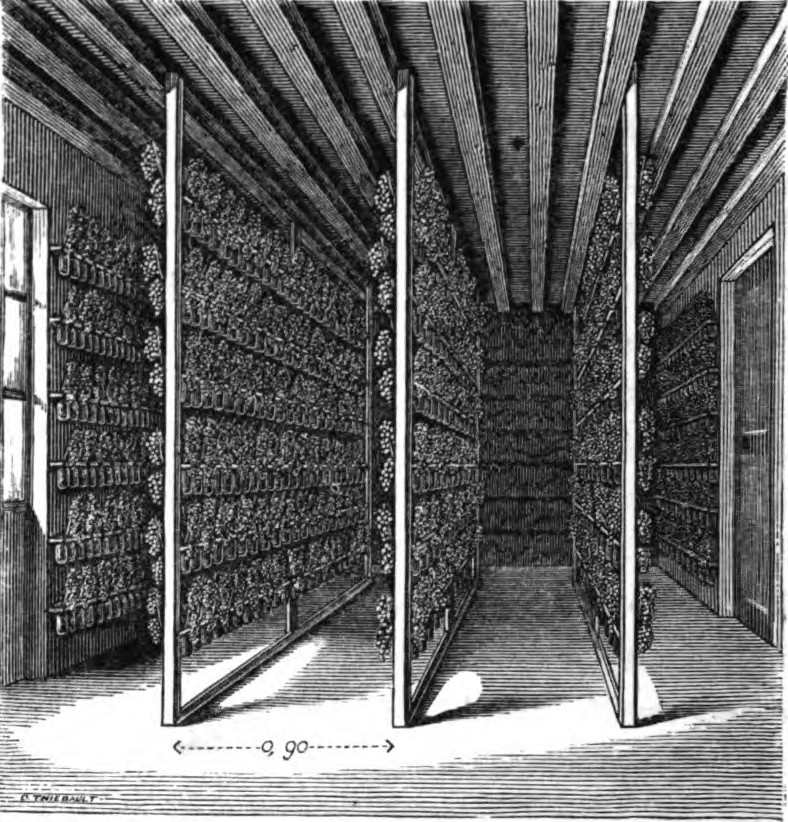
Small pieces of charcoal were also sometimes added to the water to help limit its deterioration.
What science tells us
Why did it work?
A cut bunch of grapes does not instantly become an inert object. Its tissues continue to respire and it loses water. The stem framework that carries the berries dehydrates particularly quickly.
Modern research on table grapes shows that this water loss contributes to browning of the stems, shrivelling of the berries, loss of weight and reduced firmness.
The growers of Thomery had noticed something much simpler: when a piece of vine shoot remained in contact with water, the bunch dried out more slowly.
They were not making the grapes immortal. They were slowing down one of the mechanisms of ageing.
The technique was not born from a complex machine. It came from patient observation of living things.
A delicate balance
But water was not enough
Keeping a bunch of grapes for several months required close attention. Preventing dehydration did not solve everything.
Excess humidity, a damaged berry or contamination could encourage mould. The bunches therefore had to be checked regularly, and spoiled berries removed before rot spread to their neighbours.
Even today, grape preservation depends on the same balance: limiting water loss without encouraging fungi. Botrytis cinerea, responsible for grey mould, remains one of the main causes of deterioration in table grapes after harvest.
Thomery’s success therefore depended on a whole system: good bunches to begin with, careful harvesting, water, a suitable room, relatively cool temperatures, darkness and, above all, regular inspection.
Changing the calendar
Keeping October in reserve until spring
The method made it possible to keep Chasselas harvested in autumn until April, and some technical sources even mention April-May.
By the end of the nineteenth century, more than 800 tonnes of grapes were being shipped to Paris every year.
Grapes sold in September remained a seasonal fruit. Fresh grapes placed on a table in the depths of winter became something exceptional.
Thomery had learned how to move its season.
Living heritage
A landscape built around a fruit
The Chemin des Longs Sillons still winds between the old vine walls. The plots are long, narrow and almost maze-like.
The path, its walls, and the walls and soils of the adjoining plots were listed as Historic Monuments by an order dated 5 May 1993.
Know-how does not leave behind only a recipe. It can shape a landscape, build walls, create trades, organise the work of a village, change the value of a harvest and, several generations later, become heritage.
What this inspires for the Chevaliers de l’Astrée
We often tell the story of food preservation as a succession of machines: canning, cold rooms, refrigerators, freezers.
Thomery tells a different story.
Before producing ever more cold, people sometimes knew how to work with the properties of the food itself. They knew that a wall could store a little heat, that a cool dark room slowed ageing, that a damaged grape could contaminate the others and that a dried stem warned of the fruit’s decline.
They did not know every mechanism. But they knew how to observe.
And sometimes observation came before science.
Try observing at home
Can we try it again today?
Yes, on a small scale. Not to promise six months of storage with three bottles standing in a heated kitchen, but to observe.
You can start with two similar bunches: one stored normally, the other with a piece of vine shoot kept in water in a cool, suitable place.
You can weigh the bunches at the beginning, photograph the stems, follow their browning, observe the shrivelling of the berries and watch for any mould.
A small experiment like this lets us see with our own eyes what the growers of Thomery understood long before us: after harvest, water still matters.
Important: this is an observation experiment, not a home protocol guaranteeing food safety. A bunch showing mould or deterioration should not be eaten.
The Scribe’s view
There is something strange about our time. We can buy grapes almost all year, tomatoes in winter and strawberries very early in spring.
The progress is immense, and nobody would seriously wish to return to an age when a poor harvest could become a disaster.
But perhaps we lost something along the way: our sense of wonder.
At Thomery, keeping a bunch of grapes until spring required a well-oriented wall, precise pruning, months of care, delicate harvesting, a bottle, water, a special room and regular visits.
Today, we open a supermarket door and winter seems to disappear.
People in the past did not know how to abolish the seasons. They knew how to negotiate with them.
The Scribe’s little seed
The next time a fruit begins to wrinkle in a bowl, look at it before throwing it away.
It may simply be telling, in its own way, the same story as the grapes of Thomery did a hundred and fifty years ago:
“I am losing my water.”
And a whole human history of preservation begins there.
Receive. Watch over. Pass on.
See it on 19 and 20 September 2026
Thomery Chasselas, from the gardens to the Fruitier Salomon
For the European Heritage Days, Thomery is offering eight guided visits on Saturday 19 and Sunday 20 September 2026, from 2 pm to 6 pm, with one departure every hour.
The route runs from the greenhouses and training walls of the Jardins Salomon to the fruit room, exceptionally opened for the occasion. Visits are free, in groups of 15 people, and booking is required.
Sources and reference points
- Thomery town council — Preserving Chasselas grapes.
- Municipality of Thomery — historical reference points and the first wall of 1730.
- French Ministry of Culture — Chemin des Longs Sillons.
- Thomery town council — The Fruitier Salomon.
- Scientific review on post-harvest preservation of table grapes.
- Review of table-grape preservation mechanisms.
- Official programme for the 2026 European Heritage Days in Thomery.
Image credits: vine wall at the Jardin Salomon, LPLT / Wikimedia Commons, CC BY-SA 4.0; Thomery fruit room, 1863 illustration, public domain.
Echoes of the Living World — Les Chevaliers de l’Astrée
Your voice matters
Respond to this Echo
An observation, experience or question? Share it here. Comments are reviewed before publication.
No published comments yet. You can start the conversation.