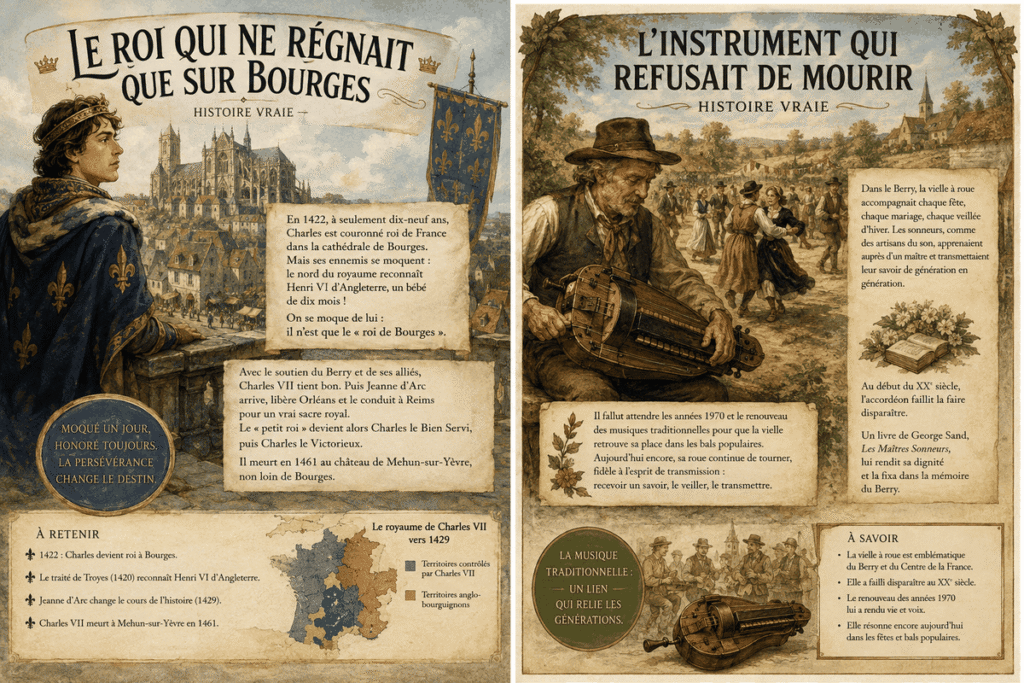
In 1422, a nineteen-year-old proclaimed himself King of France in the cathedral of Bourges. The problem was that, at the time, hardly anyone took him entirely seriously.
Driven out of Paris by the civil war between the Armagnacs and Burgundians, the dauphin Charles had withdrawn to Bourges, capital of his Duchy of Berry, where he tried as best he could to organise resistance. Northern France — and Paris itself — recognised another king: the ten-month-old English infant Henry VI, under the terms of the Treaty of Troyes. Faced with this crowned baby, poor Charles controlled only a reduced territory centred on Berry and a few neighbouring provinces. His enemies, delighted by the opportunity, mockingly nicknamed him the “little King of Bourges”.
The name might have followed him to the grave had a young peasant woman from Lorraine not arrived a few years later and helped restore the authority and confidence he lacked. Joan of Arc helped lift the siege of Orléans, then led the “little king” to Reims for a proper coronation. Charles VII, scorned only a few years earlier, ended his life with far more flattering epithets: Charles the Well-Served and Charles the Victorious. He died not far from Bourges, at the Château de Mehun-sur-Yèvre — the very castle once built by his great-uncle, John, Duke of Berry.
A delayed revenge, perhaps, but revenge nonetheless for the man who had once been reduced, in mockery, to a single city.
Your voice matters
Respond to this Echo
An observation, experience or question? Share it here. Comments are reviewed before publication.
No published comments yet. You can start the conversation.