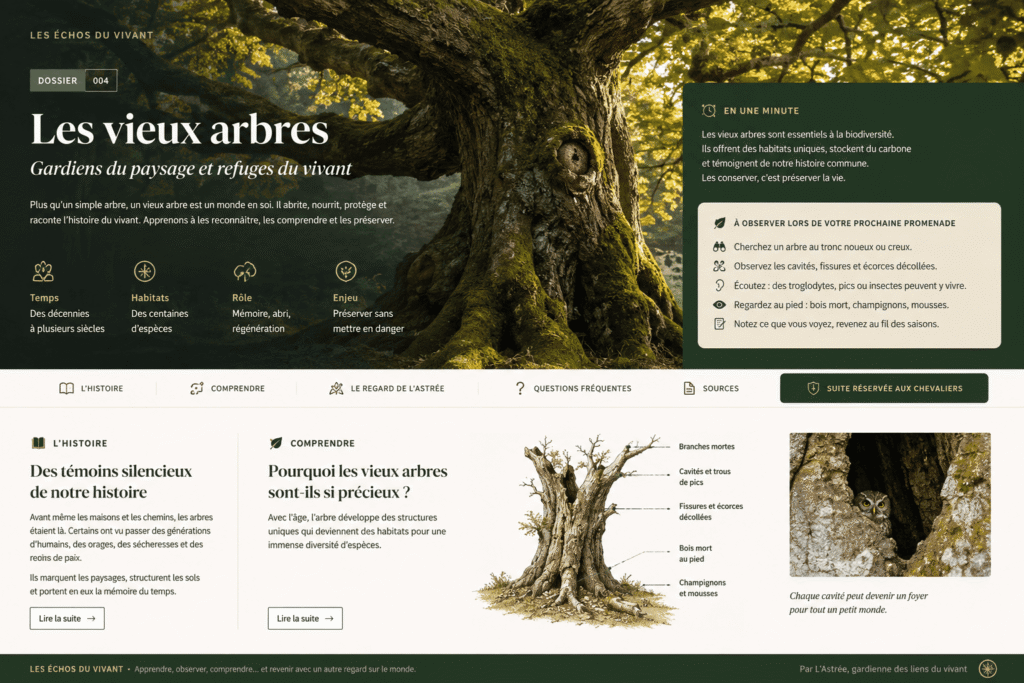
Echoes of the Living World · Trees and landscapes
Old Trees
Guardians of the landscape and refuges for wildlife
In one minute
An old tree is not necessarily a sick or doomed tree. Over time, it develops hollows, cracks, dead wood and other microhabitats used by birds, bats, insects, mosses, lichens and fungi. When it presents no proven danger, conserving it protects a habitat that has taken decades to form.
In this feature
- When a tree becomes a habitat
- Recognising its microhabitats
- Understanding the role of dead wood
- Balancing biodiversity and safety
- What an old tree brings to a place
- Frequently asked questions
A hollow trunk, a dead branch, split bark: these signs are often interpreted as proof that a tree should be removed. Yet they can also reveal that it has become an exceptionally rich living environment.
Time slowly transforms a tree. Wind breaks a branch, rain enters a wound, fungi decompose part of the wood and insects bore their galleries. Gradually, shelters and resources appear that younger trees do not yet provide.
✦
A vertical world
When does a tree become a habitat tree?
A habitat tree carries one or more small natural environments, sometimes known as tree-related microhabitats. These may include a hollow, a broken branch, a pocket of decayed material inside the trunk, loose bark, sap flow or an area of dead wood.
These structures can provide shelter, breeding sites, hibernation spaces or food. They do not depend on age alone: a younger tree may also develop them after damage or breakage. Large old trees, however, have usually had far more time to accumulate them.
What to look for
The traces that tell a tree’s story
- a hollow excavated by a woodpecker or formed through decay;
- a deep crack or lifted bark;
- a dead branch still attached to the trunk;
- a fungus growing on the wood;
- a pocket of moist decayed material inside a hollow;
- mosses, lichens or ferns growing on the bark;
- exit holes made by wood-boring insects.
Observing does not mean probing. A hollow may contain a nest, a bat roost or insects sensitive to disturbance. It is better to look from a distance and avoid putting a hand or object inside.
Wood that goes on living
Why keep dead wood?
Dead wood, whether standing or lying on the ground, is an essential habitat for many species. Fungi, bacteria and saproxylic insects depend on it for all or part of their life cycle. In turn, these organisms provide food for birds and help transform wood into organic matter.
On the ground, branches and trunks decompose slowly, locally protect the soil and contribute to humus formation. Standing dead sections can provide hollows, cracks and perches.
Keeping dead wood is not appropriate in every location, however. Near a house, a busy path, a play area or in a place highly exposed to wildfire, safety and local regulations must take priority.
Assess before felling
Is a hollow tree necessarily dangerous?
No. The presence of a hollow, fungi or dead wood is not, on its own, enough to conclude that a tree is likely to fall. Risk depends on many factors: species, architecture, root condition, extent of defects, exposure to wind, soil conditions and how frequently the area beneath the tree is used.
When a tree could threaten people or a building, its condition should be assessed on site by a suitably qualified professional. Several options may sometimes be possible before complete removal: targeted reduction of a branch, restricting access to the area, retaining a reduced standing trunk or keeping the wood on the ground in a suitable place.
Caution
This feature cannot be used to diagnose a tree’s structural safety. A photograph, or the presence of a hollow alone, is no substitute for an on-site inspection.
Living heritage
What an old tree brings to a place
A large tree provides shade, intercepts some rainfall and creates a cooler microclimate beneath its canopy. Its roots and the life of the surrounding soil contribute to ground stability and water movement.
Its trunk and branches store carbon accumulated throughout its growth. A young tree can prepare the future, but it will need time to develop the volume, hollows and biological complexity of an old one. Planting and conserving are therefore complementary actions, not interchangeable ones.
Old trees are also cultural landmarks. They can mark a square, a path, a farm or an ancient boundary. Some have accompanied several generations and form part of the memory of a landscape.
Key points
- An old tree is not necessarily a dangerous tree.
- Hollows, cracks and dead sections create valuable microhabitats.
- Dead wood supports the soil and many food webs.
- Safety must be assessed according to the individual tree and its real surroundings.
- Conserving an old tree and planting its successor are complementary actions.
Frequently asked questions
Common questions about old trees
Is a hollow tree dead?
Not necessarily. The living tissues that carry sap are mainly located near the outside of the trunk. A tree can continue to live and produce leaves despite a central hollow. Should all dead branches be removed?
No. In an area with no public access or safety concern, they may be retained for biodiversity. Near people or buildings, keeping them should be assessed. Do fungi always mean the tree is doomed?
No. Their presence indicates wood decay, but the consequences vary according to the fungus, its location and the overall condition of the tree. An on-site assessment may be necessary. Why are wood-dwelling insects useful?
Many help decompose and recycle wood. They are also an important food source for birds, bats and other animals. Can refuges be created without keeping a dangerous tree?
Yes. Depending on the context, part of the trunk may sometimes be retained, or the wood placed safely on the ground elsewhere. The solution must take wildfire risk and the way the site is used into account. Does a young tree immediately replace an old one?
No. It prepares the next generation, but it does not yet provide the volume, hollows and microhabitats that an old tree has developed over decades.
Astrée’s perspective
An old tree carries more than branches. It carries seasons, refuges and sometimes the memory of a path. What a hurried eye calls a wound may be, for another living creature, the doorway to a home.
Sources and further reading
- French Biodiversity Agency — the hidden treasures of dead wood
- French Biodiversity Agency — terrestrial habitats and microhabitats
- INRAE — understanding, conserving and promoting habitat trees
- INRAE — tree hollows and wild bee colonies
Continue the feature
In the Chevaliers’ Realm
An observation sheet helps describe a habitat tree without disturbing it and creates a record of its hollows, surroundings and the species seen there.
Your voice matters
Respond to this Echo
An observation, experience or question? Share it here. Comments are reviewed before publication.
No published comments yet. You can start the conversation.