Echoes of the Living World · Les Chevaliers de l’Astrée · Terres d’Aragon Estate
The stones and rivers of the Matarraña tell a story measured in geological time. Its villages, languages and borders tell the story of people.
In this corner of eastern Aragon, different legacies have met for centuries. From Iberian communities to today’s villages, inhabitants have cultivated the land, managed water, built houses, endured conflict and passed on skills. The landscape we see today is the result of that long history.
This is the second of two companion essays. The first, “The Matarraña: A Story Written in Stone and Water”, explores geology, rivers and wildlife. This one follows the women and men who lived in these valleys.
A brief chronology
- 6th–2nd centuries BC: Iberian settlements develop in Lower Aragon.
- From 218 BC: Rome begins the conquest of the Iberian Peninsula.
- 8th–12th centuries: Muslim powers govern parts of present-day Aragon.
- c. 1165–1170: Christian conquest of the Valderrobres area.
- 1175: Alfonso II grants Valderrobres to the bishop of Zaragoza and his cathedral chapter.
- 1307: episcopal jurisdiction is reaffirmed.
- 14th–15th centuries: castle-palace, Gothic church and stone bridge take shape.
- 1429: the Cortes of Aragon meet at Valderrobres.
- 1640–1652: war linked to the Catalan revolt affects the borderlands.
- 19th century: seigneurial institutions decline; the Carlist Wars shake the region.
- 1936–1939: Spanish Civil War.
- 20th–21st centuries: rural exodus, economic change and renewed attention to heritage and nature.
1. Before Aragon: the Iberian peoples
Long before medieval kingdoms, communities belonging to the Iberian cultural world inhabited the Matarraña valleys. Archaeological sites in Lower Aragon reveal organised villages, trade, farming and craftsmanship dating back more than two thousand years.
Villages on the heights
Near Calaceite, the San Antonio settlement preserves the remains of streets and rectangular houses. Its earlier occupation dates to the fifth and fourth centuries BC, with important development during the third century BC. Nearby Tossal Redó provides further evidence of Iberian settlement.
Between Cretas and Calaceite, the fortified site of Els Castellans attracted archaeologists early in the twentieth century. Excavations associated with Pere Bosch Gimpera and Lorenzo Pérez Temprado helped illuminate the region’s distant past. Around Mazaleón, Piuró del Barranc Fondo and San Cristóbal add to this archaeological landscape.
These sites remind us that the land had a history long before the villages we know today. Families lived, worked, raised children and built homes here, just as later generations would.
Who were the Iberians?
The word Iberian did not designate a single nation. Greek and Roman writers used it for different populations of eastern and southern Iberia, whose customs, political structures and languages were not all identical.
These communities cultivated cereals, raised animals, made pottery, worked metals and traded across the Mediterranean world. Iberian inscriptions survive, and scholars can identify many of their signs, although the language itself is still only partly understood.
These people were neither Aragonese nor Spanish in the modern sense. Yet they belong fully to the history of the Matarraña.
2. Roman times: a valley connected to a wider world
From 218 BC, Rome began its conquest of the Iberian Peninsula. Incorporation into Roman rule was gradual and altered political authority, trade routes and ways of organising society.
The Iberian settlement of San Antonio was abandoned around the end of the third or beginning of the second century BC, in a period of far-reaching change. Archaeological research cautions against attributing that abandonment to a single event without evidence.
The mausoleum of Fabara
At Fabara, among agricultural fields, stands the Roman mausoleum of Lucius Aemilius Lupus. Built in the second century AD, this small temple-like tomb is among the best-preserved Roman funerary monuments in Spain.
It reminds us that this apparently quiet rural area once belonged to an empire of roads, trade, administration and shared artistic forms. Visitors should check access arrangements with the municipality or the regional heritage services before travelling.
Today’s agricultural landscape has been shaped by many successive periods. An old olive tree, even of the local Empeltre variety, cannot be dated to Roman times merely from its appearance.
3. Al-Andalus: conquest, coexistence and change
In 711, armies arriving from North Africa crossed the Strait of Gibraltar and began the conquest of the Visigothic kingdom. By about 714 they had reached the Ebro valley in what is now Aragon.
The transfer of power did not happen everywhere in the same way. Some towns resisted; elsewhere agreements were negotiated. Christian communities continued to live under Muslim rule, generally with particular fiscal obligations, while other inhabitants gradually adopted Islam and new cultural practices.
Coexistence should not be romanticised. It did not mean equal rights, and political rivalries, rebellions and wars brought violence. Written evidence for the Matarraña itself is limited. Historians also discuss the presence of Berber populations, whose legacy may survive in some place names.
Water: a resource to manage and share
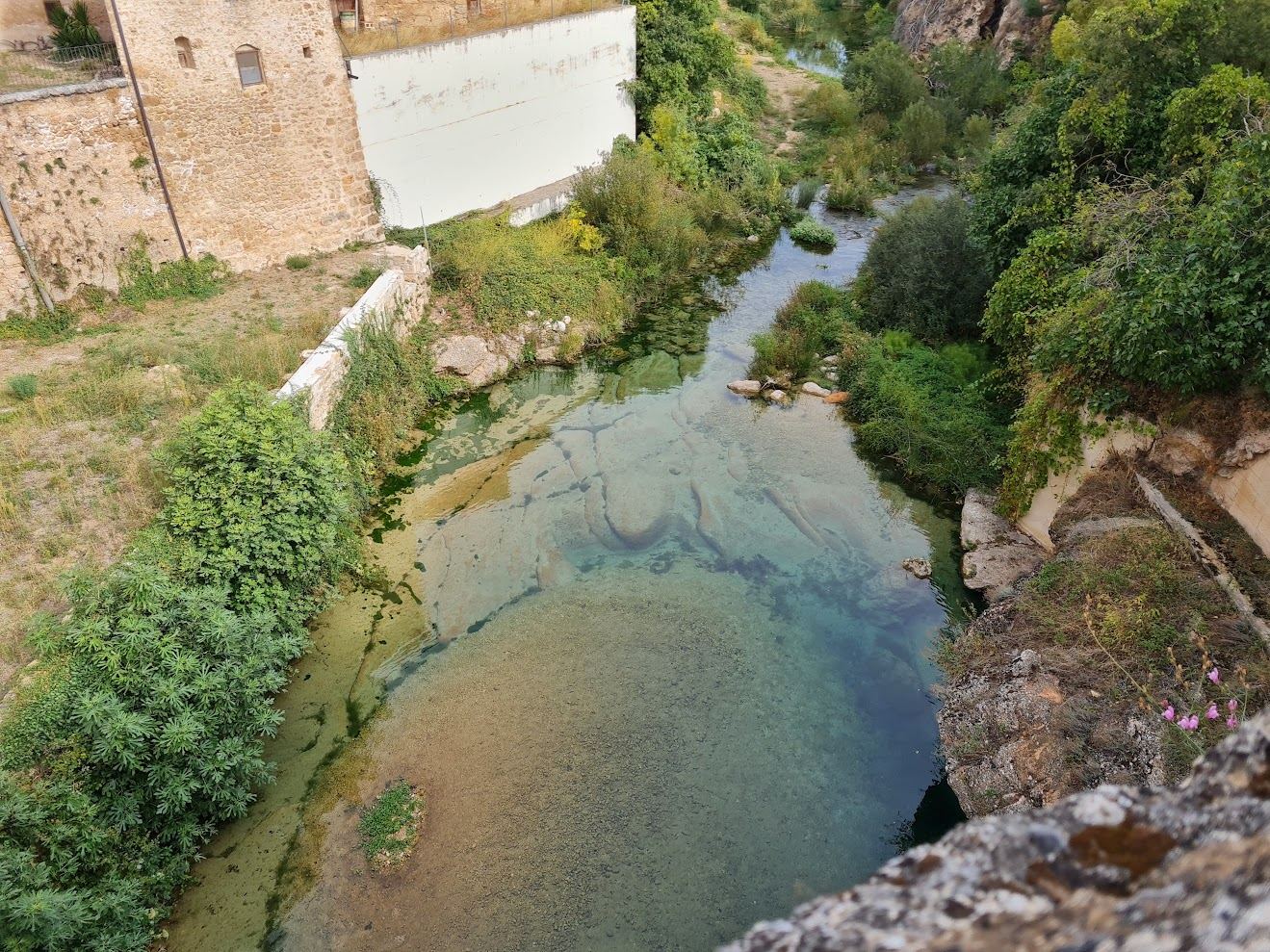
In Mediterranean valleys, water is precious and irregular. Heavy rain can rapidly swell rivers; long summers can dry the soil. For generations, growing food has meant adapting to this uncertainty.
Irrigation existed in Iberia before the Muslim conquest, but many systems expanded and became more organised during the centuries of al-Andalus. Diversion structures, channels and reservoirs helped guide water towards fields, sometimes by gravity and sometimes with lifting devices.
Such systems also demanded agreements. Who could water first? Who maintained a channel after a flood? How could disputes between neighbours be settled? Water management was a collective responsibility.
Its linguistic legacy survives in words such as Spanish acequia and alberca, and Catalan séquia. But not every surviving irrigation channel dates from Muslim times: some are older, and many were altered or extended after the Christian conquest.
The region’s history was written not only in castles and battles, but beside channels and fields, where neighbours had to share an indispensable resource.
4. Christian conquest and a new political order
In the twelfth century, Christian conquests advanced across eastern Iberia. Around 1165–1170, the Valderrobres area passed under Christian control, beginning a lasting reorganisation of authority, settlement and landholding.
For ordinary families, conquest was not simply the day a fortress changed hands. Fields still needed tending and families still needed feeding. But laws, obligations and the people entitled to collect dues could change.
1175: Valderrobres granted to a bishop
In 1175, King Alfonso II of Aragon granted Valderrobres to Pedro Torroja, bishop of Zaragoza, and his cathedral chapter. Seigneurial rights were subsequently exercised within a complex system, including fief-holders, before episcopal lordship was consolidated in 1307.
A medieval bishop could be more than a religious leader. He might also exercise temporal authority, collect revenues and hold judicial rights. For farmers, these arrangements determined whom they owed dues and which authority could settle disputes.
What was the Crown of Aragon?
The Crown of Aragon was not simply the present-day region of Aragon. It brought together several territories under one sovereign, while retaining distinct laws, institutions and customs. The kingdom of Aragon and the Catalan lands formed its core; expansion in the thirteenth century added Valencia and the Balearic Islands.
Kings left names in chronicles, bishops left charters and monuments. Most inhabitants left something less obvious but just as enduring: a landscape shaped by generations of work.
5. Valderrobres: when buildings speak of power
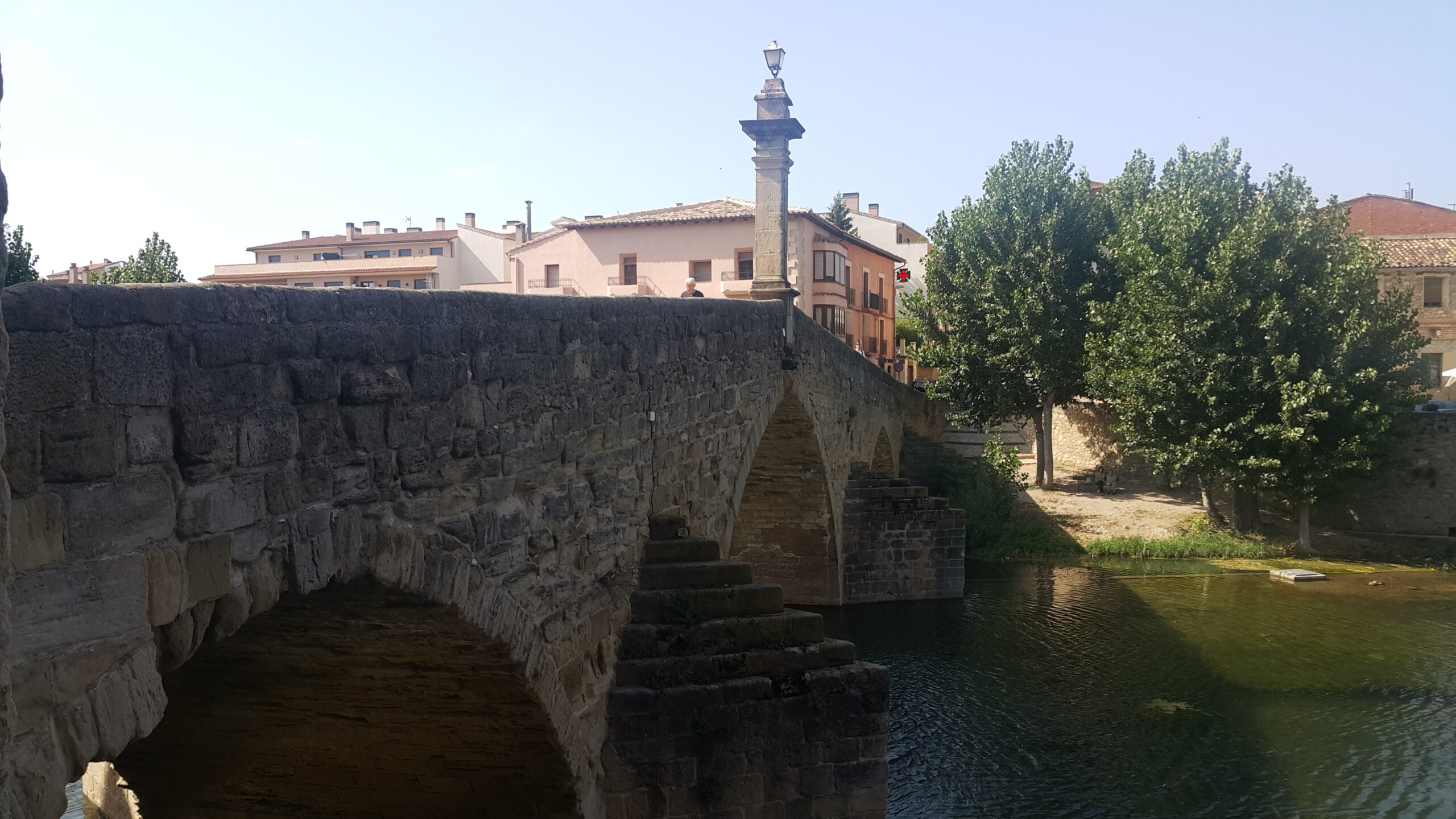
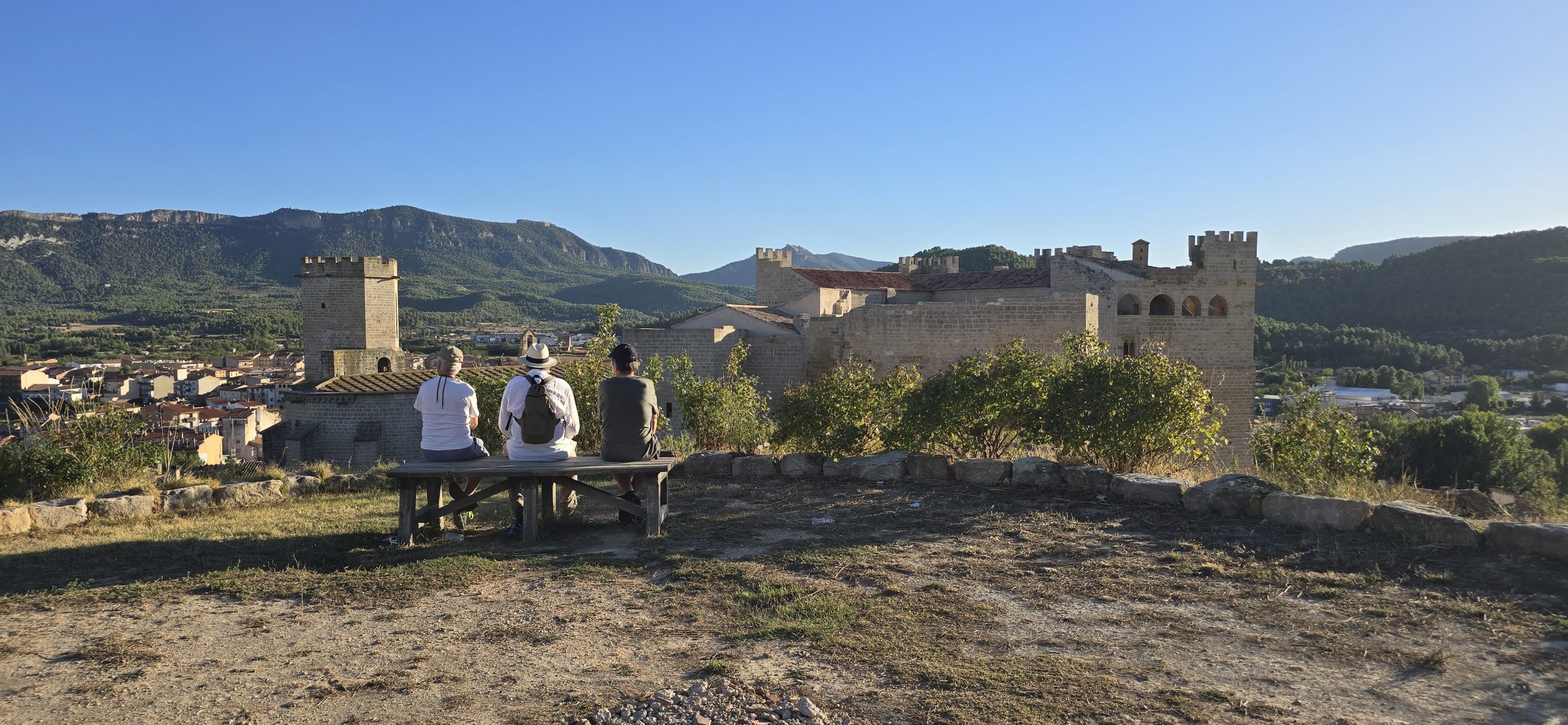
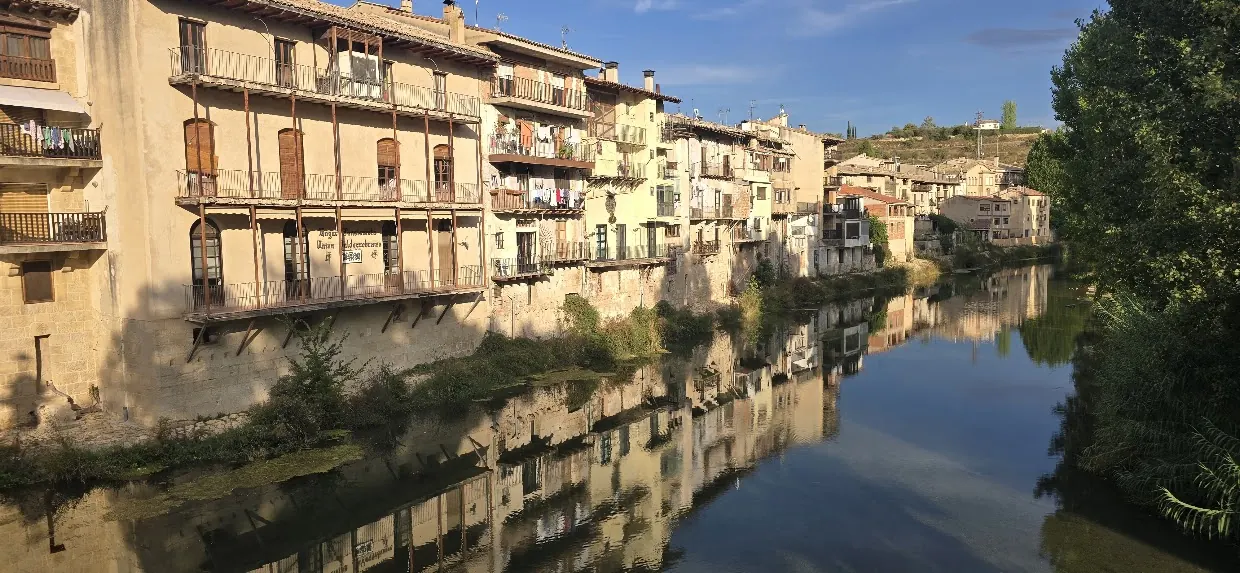
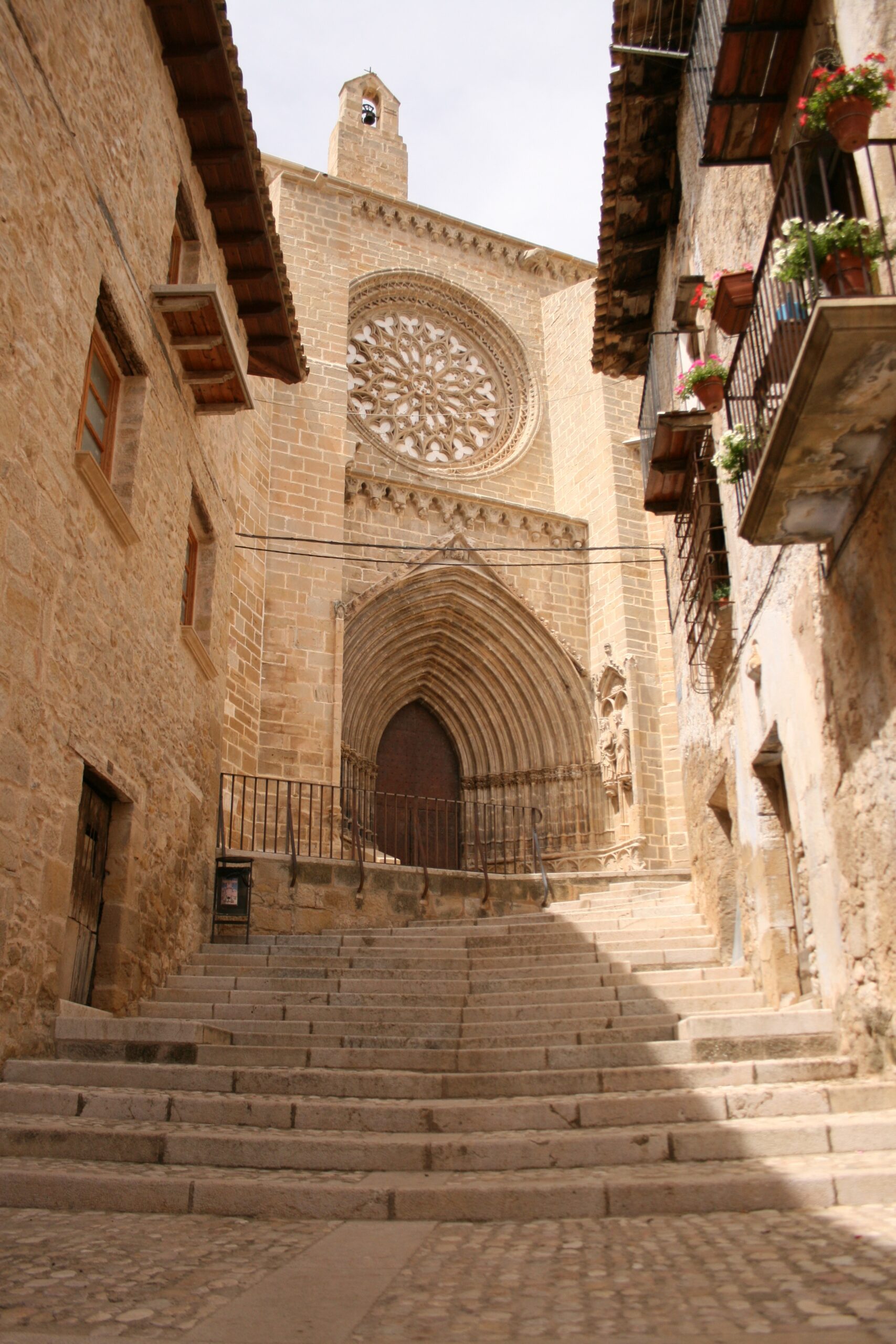
Valderrobres appears around a bend in the road, its stone houses clustered beneath a hill, its castle rising above the roofs and its old bridge crossing the Matarraña. Today it seems peaceful, but its buildings tell of centuries of authority and change.
Under the bishops of Zaragoza, an older stronghold gradually became an imposing castle-palace. Nearby stands the Gothic church of Santa María la Mayor. Below them, the stone bridge, begun in the late fourteenth century, links the two banks and has had to withstand the river’s sudden floods.
In 1429, Valderrobres hosted sessions of the Cortes of Aragon in the presence of King Alfonso V. For a time, this small town became one of the places where the affairs of a kingdom were debated.
What happened within the castle walls? How did families live in the narrow streets? Why was this town chosen as a meeting place? Those questions deserve their own essay, “Valderrobres, the Town Where Stones Tell Human Stories.”
Other villages, other histories
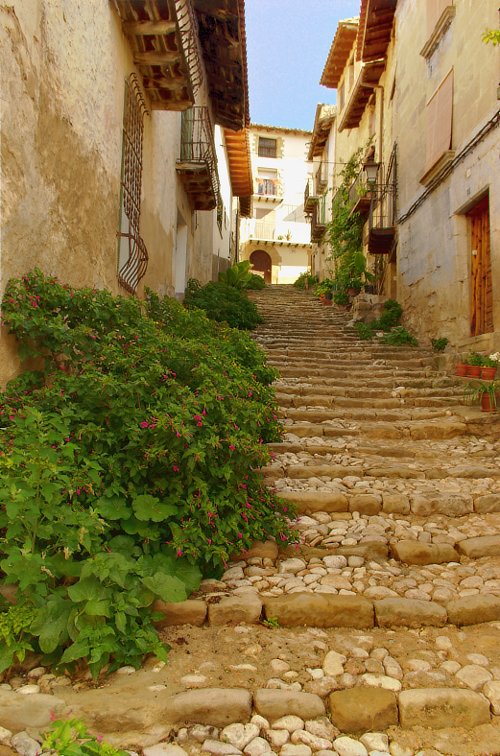
Calaceite, Cretas, Beceite, Fabara and Mazaleón each have their own heritage. Old streets, arcades, fountains, mills and washhouses preserve evidence of many generations. A stone village rarely belongs to one period alone: its buildings are an accumulation of repairs, changes and different ways of living.
6. A land where languages cross borders
In the Matarraña, political borders never tell the whole story. A conversation may begin in Spanish and continue in the local speech of a village. Words and accents change, but daily life is shared.
The region belongs to Aragon and also forms part of the Franja, the eastern Aragonese area where varieties of Catalan have traditionally been spoken. The Franja is not a single administrative province or region; it is a linguistic area with diverse local identities.
Words passed from one generation to the next
Language lives in kitchens, markets, fields and family conversations, not only in books. Names for plants, tools, paths and food carry the memory of generations.
Linguists generally classify the traditional speech of the Matarraña as varieties of Catalan. Yet naming one’s own language is also a matter of identity. Some inhabitants use the term chapurriau; others prefer catalán or simply the name of their village.
In 2013, an Aragonese law used a geographical designation for the language of eastern Aragon, widely referred to in public debate by the controversial acronym LAPAO. The 2013 law remains in force; however, a 2016 amendment to Aragon’s cultural heritage legislation explicitly recognises Catalan of Aragon and Aragonese, including their dialect varieties.
Behind these debates are living languages and people whose identities cannot be reduced to labels.
The Algars: a river between territories
Along part of its course, the Algars marks the boundary between Aragon and Catalonia. On a map it is a clear dividing line; in daily life, relationships between the two banks have often been much more fluid.
For centuries, markets, roads, farming and family ties connected nearby communities. War and political decisions sometimes interrupted these exchanges, but the proximity of villages and the continuity of the landscape encouraged lasting links.
7. From the seventeenth to the nineteenth century: wars and the end of lordship
Terraces and dry-stone walls speak of work repeated over centuries. Olive and almond trees grow where families have learned to manage thin soils, irregular rainfall and the need to protect harvests. Political conflicts, however, repeatedly disturbed that everyday rhythm.
1640: war in the borderlands
In 1640, revolt broke out in Catalonia against the Spanish monarchy, triggering a prolonged conflict that lasted into the early 1650s. The Matarraña, in Aragon close to the Catalan border, belonged to a region affected by military movements, requisitions and insecurity. The effects varied by locality, and should not be described as identical in every village.
The nineteenth century and the Carlist Wars
The nineteenth century brought profound changes in Spain: the weakening and eventual abolition of many seigneurial jurisdictions, political liberalism and repeated civil conflict.
The Carlist Wars particularly affected the Maestrazgo and parts of eastern Aragon. Their history must nevertheless be distinguished from the specific experience of each Matarraña village.
Political regimes changed, old authorities disappeared and wars eventually receded. Yet the terraces remained, and later generations continued repairing walls, tending trees and walking paths opened by their predecessors.
8. The twentieth century: war, departure and quiet fields
At the start of the twentieth century, life in the Matarraña remained closely tied to olives, almonds, cereals and livestock. Spain, however, was entering a period of deep political and social tension.
1936: Spain torn apart
In July 1936, part of the Spanish army rebelled against the Republic. The coup failed to seize the whole country and led to a civil war lasting almost three years. Aragon soon became a major area of confrontation.
In rural eastern Aragon, war was accompanied by social revolution. Anarchist and trade-union organisations helped establish agricultural collectives in which some land and means of production were pooled. These experiments differed from village to village and were not accepted by everyone.
The period combined hopes of change with coercion, divisions and violence. For families, political events became part of everyday life as authorities changed and relationships between neighbours were strained.
1938: the front advances
In spring 1938, General Franco’s forces launched a major offensive in Aragon. Republican positions retreated. On 15 April 1938, Francoist troops reached the Mediterranean at Vinaròs, dividing the remaining Republican-held territory.
From July to November, the Battle of the Ebro took place farther east, particularly in neighbouring Catalonia. It became one of the longest and bloodiest battles of the war. The Matarraña was part of the wider geography of the conflict, but fighting in its individual villages must be distinguished from operations elsewhere.
For civilians, war brought fear, shortages, displacement, family separation and the threat of reprisals. Behind military dates and movements lie lives whose traces sometimes survive in archives and testimonies.
After the war: rebuilding and silence
Franco’s victory in 1939 ended the Civil War but not its consequences. Spain entered a long dictatorship marked by repression, imprisonment, exile and economic hardship.
In villages, families resumed cultivation, repaired what they could and sought a livelihood in an impoverished country. Memories remained painful and often difficult to discuss publicly. Understanding this period requires care with archives, testimony and the diversity of individual experiences.
When young people left the villages
As Spain industrialised and urbanised in the middle decades of the twentieth century, factories, construction and services offered more work in cities. Many rural young people left to seek better opportunities, in Spain or abroad.
Like much of Teruel province, the Matarraña experienced rural depopulation. Schools lost pupils, shops closed and some fields were no longer cultivated. Without maintenance, terrace walls deteriorated, old paths became overgrown and neglected trees went unpruned.
Vegetation returned to some places, but that did not necessarily increase biodiversity: the outcome depends on habitats, species and the way landscapes evolve.
New life for the villages
From the late twentieth century onwards, architectural heritage gained recognition and rural tourism expanded. These changes helped make the region better known, but did not resolve every difficulty.
Agriculture and livestock farming remain important. Intensive pig farming in particular raises questions about water use, waste and environmental protection. An ageing population, economic pressures and climate change pose further challenges.
The goal cannot be merely to preserve picturesque buildings for visitors. Villages must remain places where people can live, work and raise children.
9. The Matarraña today: between heritage and the future
The Matarraña is not frozen in the past. Behind its stone façades and admired landscapes, people continue to build their lives. The towns of this comarca in Teruel province possess remarkable heritage, but they are not open-air museums.
A ‘Spanish Tuscany’?
The region is sometimes called “the Spanish Tuscany”: hilltop villages, golden stone houses, olive-covered hills and winding roads make the comparison tempting. Yet the Matarraña has its own identity, shaped by Aragon, Catalonia and the Mediterranean world.
Its villages have their own traditions and ways of speaking. The beauty of the scenery should not conceal the economic and social challenges of rural life.
A land still at work
Farmers and livestock keepers must adapt to changing markets, drought, rising costs and the difficulty of passing businesses to the next generation. The river, too, must meet human and agricultural needs without losing its ecological vitality.
Local people face a difficult balance: welcoming visitors while protecting year-round community life, services, housing and work. A place should not become a stage set simply because others admire it.
Biodiversity: a less visible heritage
Heritage also lives in rivers, forests, scrubland, agricultural terraces and old trees. Cultivated and natural habitats form a mosaic supporting pollinators, birds and small animals.
Abandonment of some fields, intensification elsewhere, wildfire, drought and climate change can all alter this balance. Protecting nature does not always mean leaving everything untouched. It requires observation, understanding and sometimes careful intervention.
10. At Terres d’Aragon, the story continues
A few kilometres from Valderrobres, our journey reaches a real place: approximately three hectares of olive and almond trees. We call it Terres d’Aragon, one of the estates of Les Chevaliers de l’Astrée.
There is no medieval castle or famous monument on this land. Yet after the villages, wars and landscapes described in this essay, it is here that history meets our present: on cultivated ground shaped by generations whose work we hope, in our own way, to continue.
Trees that came before us
We do not know the exact age of every tree or the names of those who planted them. But their presence tells a story of preparing soil, planting, pruning, harvesting and accepting both generous and difficult years.
We did not create this landscape. We received it.
More life than first meets the eye
Between the cultivated trees grow thyme, rosemary, wild lavenders, heathers and aromatic plants, some with an anise-like scent. Two fig trees follow the rhythm of the seasons. Flowers provide resources for insects, shrubs offer shelter and trees cast shade.
Much remains to be observed before we can know precisely which species live on the estate. That is exactly what we intend to do.
Preserve before transforming
Our first aim is not to remake the estate, but to understand it. We want to maintain the existing olive and almond trees, care for those that need attention and preserve spontaneous vegetation where appropriate.
We may eventually plant a pomegranate tree and encourage the lavender that already seems to thrive. But planting more is not always an improvement. New plants can demand water, compete with established species or disturb existing relationships. Observe first; intervene second.
The seasons as a calendar
At the end of winter, almond blossom may announce spring before the cold nights are over. Summer brings leaves, developing fruit and long weeks of heat. Fig trees shed their leaves in autumn, while olive trees remain evergreen and rosemary may flower at different times.
Every season changes the estate without erasing its identity. That continuity is what we want to learn to see.
A place to share, not to own
Members of Les Chevaliers de l’Astrée can form a personal, lifelong connection with a real, precisely located and referenced parcel on the estate. This connection does not confer ownership of the land. It is an invitation to learn about a place, follow its changes and take an interest in its care.
People living in different countries, who may never speak the same language or share the same habits, can thus feel connected to one small piece of nature.
What we hope to pass on
We cannot know what Terres d’Aragon will look like in fifty years. Some trees will have disappeared; others will have grown. We hope future generations will still find olive and almond trees, wild plants and the quiet diversity of Mediterranean habitats.
The Iberian communities changed, castles passed from one ruler to another, kingdoms redrew borders and villages endured wars. Through it all, people continued planting trees, tending paths and handing on what they had received.
Today, in our own small way, we wish to continue that story.
Receive. Watch over. Pass on.
We care for what will outlive us.
Your voice matters
Respond to this Echo
An observation, experience or question? Share it here. Comments are reviewed before publication.
No published comments yet. You can start the conversation.