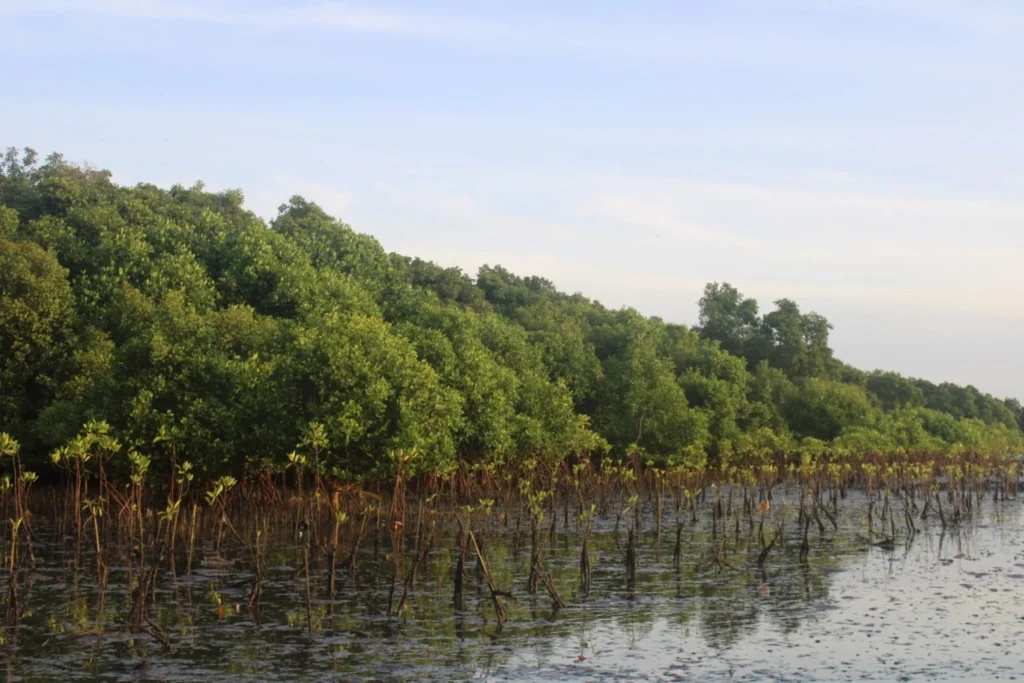
Young mangroves along the shore in Bali. Photo: I Kadek Angga Raditya.
A personal perspective on the coastal forests—and the patient work of protecting them.
By I Kadek Angga Raditya · Universitas Udayana, Bali, Indonesia
Bali is often described in bright colours: beaches, temple ceremonies and rice terraces. But some of the photographs I value most are quieter. In one image I took, a young mangrove seedling is held against the fading light; in another, an aircraft crosses the sky above a mangrove-lined coast. The contrast stays with me. One scene suggests the patience needed to protect a place, while the other reminds us how quickly that place is changing. It is a side of Bali that rarely fits on a postcard.

A forest at the water’s edge
Near Benoa Bay in southern Bali, Ngurah Rai Grand Forest Park shelters mangroves beside roads, neighbourhoods and tourism infrastructure. Seen from a distance, the forest may look like a continuous strip of green. Up close, it is a web of roots, mud, tidal water and small lives. Researchers from Universitas Udayana reported seven mangrove species and 15 epifaunal taxa in the areas they studied, including mangroves such as Rhizophora apiculata and Sonneratia alba. Biodiversity here is not always spectacular. It can be a small creature moving across the sediment, almost unnoticed.
Mangroves do more than create scenery. Where conditions are suitable, their roots help hold sediment and reduce wave energy. Their sheltered waters support fish and other coastal life, and their soils store carbon. Yet it would be a mistake to judge a forest only by how many trees have been planted. Water movement, pollution, species composition and the survival of young plants all shape whether that forest can function over time.
Young people and the work of restoration
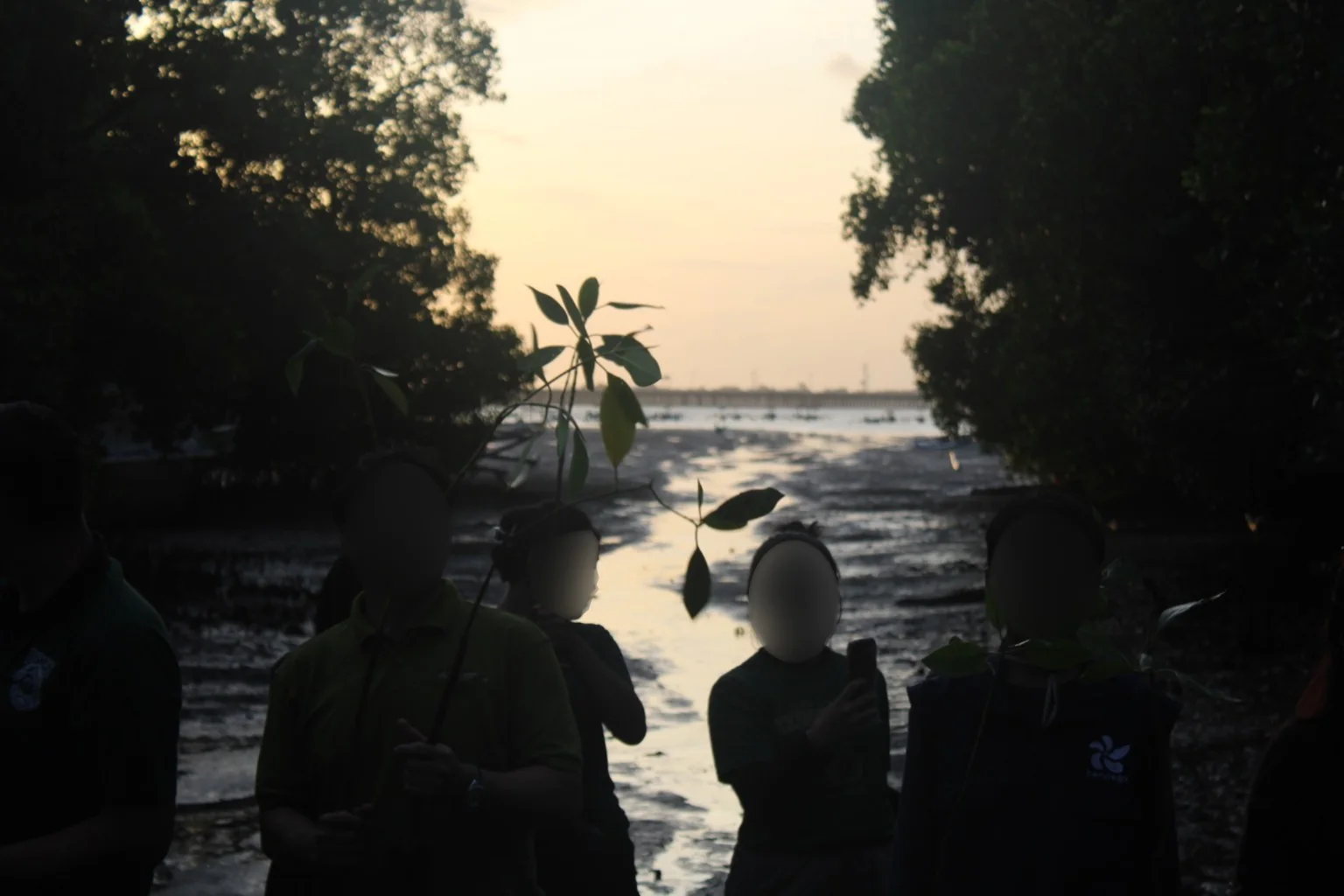
For Bali’s young people, the challenge is already tangible. In February 2026, the Denpasar city government held a mangrove exploration and clean-up in Batu Lumbung, Pemogan. At least 200 participants, including school students, university students and community groups, took part in activities to remove plastic waste from the mangrove environment. The scene illustrates an uncomfortable connection: rubbish discarded far from the shore can travel through waterways and end up among mangrove roots. The coast remembers habits formed inland.
A second story comes from Serangan, where young residents and Universitas Warmadewa have worked on mangrove rehabilitation. A university report published in September 2026 described monitoring in the Green Youth Mangrove Project area between June 2024 and May 2025. Only about one in ten previously planted seedlings had survived there. This figure belongs to that particular project, not to all of Bali. Its significance is in the response: developing nursery facilities and protective structures rather than treating planting day as the finish line. A photograph of a new seedling is hopeful; evidence that it is still growing a year later is more persuasive.
Conservation specialists have long warned that restoration cannot succeed on enthusiasm alone. The right species must match the site, natural tidal exchange must work, and local people need a meaningful role in decisions and care. Sometimes the most useful action is to repair the conditions that allow mangroves to regenerate naturally. Checking survival, recording changes and clearing trapped waste may attract fewer cameras than a mass planting event, but this quieter work is where commitment becomes measurable.
Mangroves and community health
As a medical student, I cannot separate this landscape from the question of health. We usually discuss prevention through vaccines, screening and health education. Those are essential. So are the natural systems supporting food, livelihoods and safer coastal environments. The World Health Organization has drawn attention to the connections between biodiversity and human wellbeing. Mangroves are not a treatment for illness, and a forest cannot protect a community from every hazard. Still, caring for ecological conditions belongs in any serious conversation about long-term community resilience.
A responsibility shared across generations
There is a Balinese way of reflecting on these relationships. Tri Hita Karana speaks of harmony among people, nature and the spiritual dimension of life. That philosophy should not be used as a convenient slogan or as a substitute for listening to communities. Instead, it offers a question worth carrying into decisions about development: what is gained if a coastline becomes more impressive to visit but less able to sustain the lives around it?
Young people do not need to be experts to begin, but good intentions must be paired with humility. Students can help with supervised clean-ups, monitor restoration sites, share reliable information and support community-led programmes. Local knowledge deserves attention, and projects should report survival and ecological results rather than counting participants alone. Visitors have a part too: learn what the mangroves do, respect sensitive areas and leave less waste behind.
My photographs capture only moments: hands around a fragile plant, trees standing at the water’s edge, an airplane moving across the sky. They cannot show what happens to a seedling after the camera is lowered. That is precisely the point. Beyond Bali’s famous views lies a slower responsibility, shared across generations. If we want the island to remain beautiful for visitors, it must also remain healthy and liveable for the people and other species that call it home.
About the author
I Kadek Angga Raditya is a fifth-semester medical student at the Faculty of Medicine, Universitas Udayana, Bali, Indonesia. He serves as Secretary of Social Project Bali and works on community-oriented activities and evidence-based health communication. His interests include public health, environmental awareness and the ways healthy ecosystems support healthy communities.
Sources
- Girsang, Pertami and Ernawati (2023) — Epifauna and mangrove species at Ngurah Rai Grand Forest Park
- City of Denpasar (19 February 2026) — Mangrove exploration and coastal clean-up in Pemogan
- Universitas Warmadewa (2 September 2026) — Mangrove rehabilitation with young people in Serangan
- IUCN (2017) — Lessons from mass mangrove restoration
- WHO Regional Office for Europe (2021) — Nature, biodiversity and health
- Indonesian Ministry of State Secretariat (2022) — Ngurah Rai mangroves and the G20
- Bali Provincial Government (2024) — Tri Hita Karana in traditional Balinese spatial planning